
Checking on Aging Parents: 5 Things to Look for After the First Snow
The first snowfall in Toronto is a natural turning point.
It looks peaceful, but it also changes how a home functions. Walkways become slippery. Light disappears earlier. Small obstacles start to matter more.
For many families, this is the moment to start paying closer attention to aging parents and how safely they’re managing at home.
You’re not looking for major problems. You’re looking for small signs that things are becoming just a bit harder, a bit riskier, or a bit less comfortable than they were a few months ago.
A simple check-in now can prevent a fall, an emergency, or a stressful situation later in the winter.
Here are five key areas to focus on.
Walkways, Ice, and Snow Buildup
Start outside. This is where winter risks show up first.
A path that looks “cleared” may still be:
- narrow
- uneven
- icy underneath
- difficult to navigate with boots or reduced mobility
Take a close look at:
- the main walkway to the door
- steps and railings
- the path to the garbage or mailbox
- any side entrances that are still being used
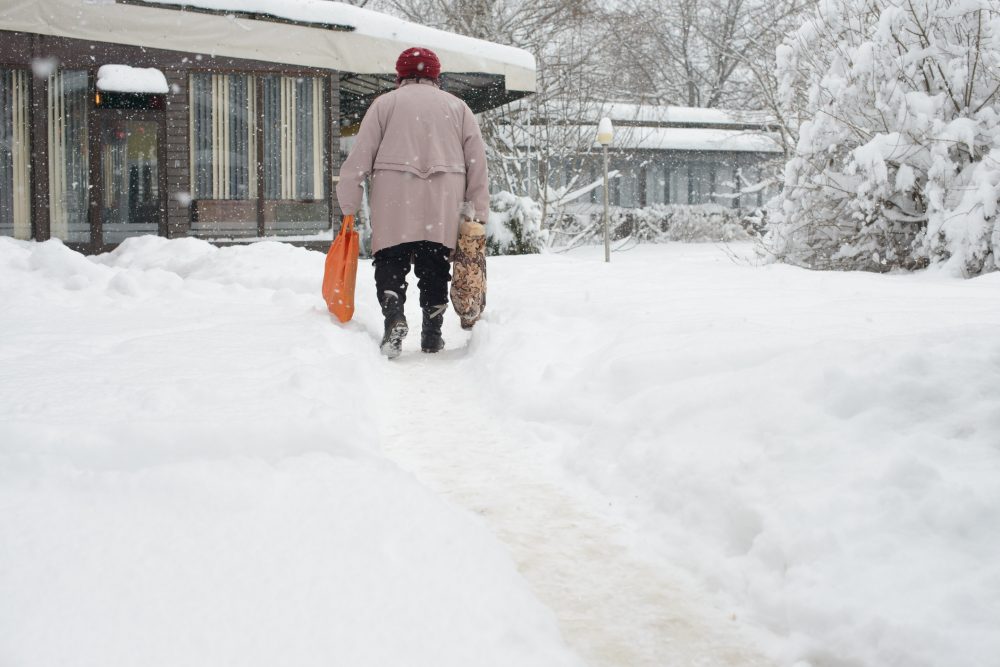
A common issue is a single narrow shoveled path, like the one in your image. It may technically be passable, but it leaves no room for balance, and any misstep leads straight into packed snow or ice.
What to check:
- Is the path wide enough for steady walking?
- Are handrails present and secure?
- Is salt or sand actually being used regularly?
- Are mats lying flat and not frozen or curled?
If this feels like too much for them to manage consistently, it usually is.
This is often the first sign that some outside help is needed, even if everything inside the home still feels fine.
Heating, Warmth, and Hidden Risks
Cold homes are more dangerous than people think.
Many older adults:
- tolerate colder temperatures than they should
- avoid adjusting thermostats
- rely on space heaters instead of central heating
You’re not just checking comfort. You’re checking safety.
What to look at:
- Is the home evenly heated, or are some rooms noticeably colder?
- Are vents blocked by furniture or rugs?
- Has the furnace filter been changed recently?
If space heaters are being used:
- Are they placed safely away from curtains and furniture?
- Are they plugged directly into outlets (not extension cords)?
- Are they stable and unlikely to tip?
Also take a moment to check:
- smoke detectors
- carbon monoxide detectors
These are easy to overlook, but critical in winter months when heating systems are working harder.
Lighting and Visibility Throughout the Home
Winter changes lighting conditions in a big way.
There’s less daylight, and more movement happens in the dark, especially:
- early mornings
- late afternoons
- nighttime trips to the bathroom
Poor lighting is one of the most common contributors to falls.
Focus on:
- entryways and exterior lighting
- hallways and stairs
- bedrooms to bathroom pathways
Ask yourself:
- Is there enough light to clearly see each step?
- Are light switches easy to reach?
- Are there dark spots or shadows?
Simple upgrades can make a huge difference:
- brighter bulbs in key areas
- night lights along hallways
- motion lights outside entrances
Good lighting is one of the easiest ways to improve safety without changing the layout of the home.
Clutter, Wet Floors, and Winter Mess
Winter creates new kinds of clutter.
Boots, mats, wet floors, and extra layers tend to collect right where they cause the most problems, near entrances and along main walking paths.
Even homes that are normally tidy can become riskier during winter.
What to check:
- Are there clear paths through main areas of the home?
- Are boots and shoes piling up near the door?
- Are rugs slipping or curling at the edges?
- Are floors wet or uneven near entrances?
Pay special attention to transitions:
- tile to hardwood
- hallway to entryway
- door thresholds
These small changes in surface can become much more dangerous when wet.
You’re not trying to make the home perfect. You’re making sure it’s easy to move through without thinking twice.
Handrails, Grab Bars, and Everyday Support
Winter increases the chance of slips, even inside.
This is the time to look closely at whether there’s something to hold onto where it matters most.
Check:
- stair railings (inside and outside)
- bathroom supports
- entry areas where shoes are removed
Ask yourself:
- Would this feel safe if someone slipped slightly?
- Is there something solid within reach?
Many homes are missing support in exactly the places it’s needed most.
Adding a grab bar or an extra railing is a small change, but it can dramatically improve confidence and reduce fall risk.
What You’re Really Looking For
When checking on aging parents, you’re not doing a formal inspection.
You’re noticing:
- what’s getting harder
- what’s being avoided
- what’s no longer being maintained consistently
You might hear things like:
- “I just go slowly”
- “I don’t use that entrance anymore”
- “It’s fine, I manage”
Those are often signs that something has already changed.
A Quick Winter Check Makes a Big Difference
Most winter safety issues don’t start as emergencies.
They start as small, manageable problems:
- a bit of ice
- a dim hallway
- a loose mat
- a missing handhold
Catching them early keeps your loved ones:
- safer
- more comfortable
- more independent
And it gives you peace of mind.
If You’re Not Sure What You’re Seeing
A lot of families reach the same point:
“I think things are okay… but I’m not completely sure.”
That uncertainty is normal.
Sometimes it helps to have someone take a careful, practical look at the home as a whole.
Not a clinical assessment. Just a structured, experienced walkthrough of:
- walkways
- lighting
- fall risks
- accessibility gaps
The goal is simple:
make the home easier and safer to live in, especially through the winter.
Support Your Loved Ones with One Call
If you want a second set of eyes on things, or help taking care of what you’ve noticed, we’re here.
Good Company – Services, Safety, and Accessibility at Home
Trained, insured professionals serving North York, Vaughan, and Richmond Hill
📞 416-894-1137
🌐 www.goodcompanyhome.com
Reliable help, right at home.
About the Author
Jesse Black-Allen is the founder of Good Company, a home services business focused on safety, accessibility, and reliable help for everyday needs. Based in North York, he serves families across Toronto, Vaughan, and Richmond Hill.
Jesse works closely with older adults and their families to make homes safer and easier to manage, especially as needs change over time. His approach is practical and straightforward, helping clients address real issues like fall risks, lighting, and home maintenance without unnecessary stress or upselling.