
Jiffy, TaskRabbit, or a Local Handyman? What Actually Works
When people hear about what we do at Good Company, they often ask:
“Isn’t that like Jiffy or TaskRabbit?”
It’s a fair question.
If you need one quick task done, platforms like Jiffy or TaskRabbit can work. They’re built for speed. You post a job, someone picks it up, and it gets handled.
But if you’re looking for something a bit more reliable, more thought-through, and less repetitive, it’s worth understanding where that model starts to break down.
If you’re searching for a TaskRabbit alternative in Toronto, this is usually what you’re really trying to figure out.
Bundling small jobs is harder than it should be
Most homes don’t have just one issue. They have a running list.
A door that sticks.
A loose handrail.
A lock that doesn’t quite catch.
A smoke alarm that won’t stop chirping.
On gig platforms, each of these becomes its own job. Its own booking. Its own minimum charge.
So you either overpay to get everything done, or you chip away at the list slowly and inconsistently.
That’s not a great system.
With us, you can hand over the list and we’ll work through it in one visit, in a logical order, with the right tools and materials already planned for.
That’s how a lot of our work begins through our installation services in Toronto, not as one-off fixes, but as a set of small improvements that actually make the home function better.
Preventative maintenance is almost nonexistent on apps
Gig platforms are reactive by design.
Something breaks, you post a job.
But most problems don’t start as emergencies. They build slowly.
A bit of water getting where it shouldn’t.
A seal wearing down.
A step or railing that’s just starting to loosen.
Left alone, these turn into bigger issues. Caught early, they’re simple.
That’s why we put so much emphasis on ongoing care through our home maintenance plans. It’s not about adding services. It’s about reducing problems.
Communication is where things often go sideways
This is one of the biggest gaps with gig apps.
Everything depends on how well a job is described in a few photos and a short message. The person showing up is interpreting that description in real time.
Sometimes that works.
Sometimes it leads to:
- mismatched expectations
- quick fixes instead of proper ones
- or small decisions being made without context
There’s also no real oversight. No one stepping back to ask whether the approach actually makes sense for the home overall.
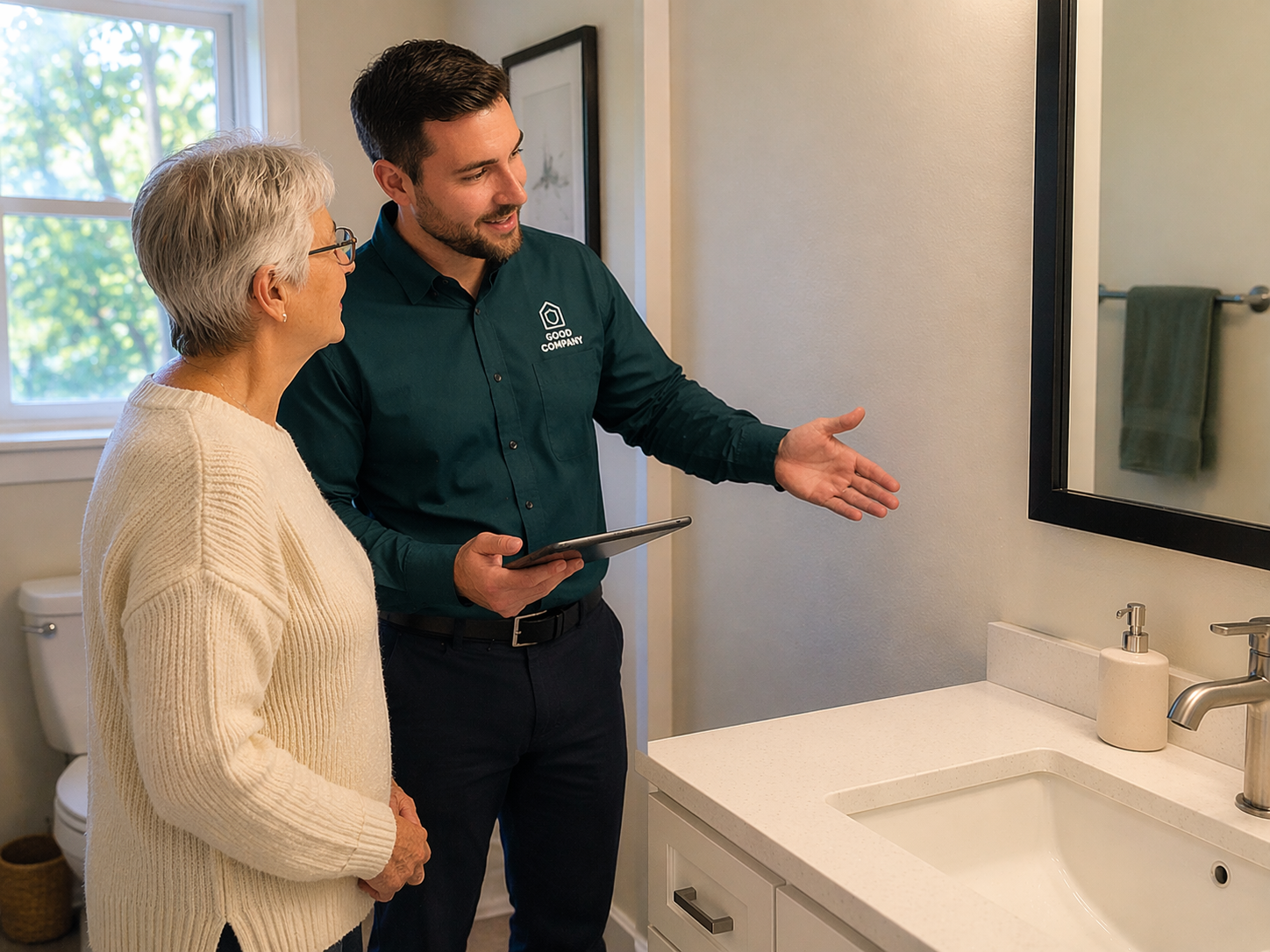
With Good Company, the work starts with a conversation. We look at the space, talk through what matters, and explain what we’re doing. That carries forward from visit to visit.
No continuity means starting over every time
Every home has its quirks.
Where the shut-offs are.
Which outlets are tied together.
Which fixes have already been tried.
With gig apps, every visit starts from zero.
That means:
- repeating yourself
- re-explaining decisions
- and sometimes undoing or adjusting previous work
With us, it builds.
We keep track of what’s been done and what still matters. In many cases, that starts with a walkthrough like our home safety assessment, and then carries forward into ongoing work.
It’s a quieter benefit, but it makes a big difference over time.
The bigger picture is usually missing
Gig platforms are designed to complete tasks.
They’re not designed to think about how those tasks connect.
So a shelf gets installed. A faucet gets tightened. A light gets replaced.
But no one is asking:
- Is this the right placement for how the space is used?
- Is there a better or safer way to handle this?
- Is this part of a pattern that should be addressed together?
That kind of thinking requires context and a bit of responsibility for the outcome.
That’s the difference.
We’re not trying to overcomplicate things. Just to make sure the work actually makes sense as part of the home.
Safety isn’t built into the model
Most homes have small risks built into them.
Lighting that’s slightly too dim.
A step that’s easy to misjudge.
A bathroom setup that works, but not comfortably.
These aren’t special situations. They’re normal.
Gig platforms aren’t set up to notice or respond to these things. They’re set up to complete a defined task.
We pay attention to them as part of the work. Not to upsell or add complexity, but to make sure the home is working the way it should.
Honest truth
If you only need one quick task done, gig apps can be a good option.
But if you have a list of jobs, want clear communication, value consistency, or want someone to think about how everything fits together, a more direct service is usually the better fit.
That’s where Good Company tends to make more sense.
One call. A set of things handled properly. And fewer loose ends to deal with later.
Not sure which direction makes sense?
If you’re deciding between using an app or working with someone directly, I’m happy to take a quick look at what you’re dealing with and give you a straightforward recommendation.
No pressure either way.
Call or text: 416-894-1137
How Good Company compares
Here’s a simple way to think about the difference:
| Feature | Jiffy / TaskRabbit | Good Company |
|---|---|---|
| Type of service | Gig-based, one-off jobs | Professional, ongoing support |
| Small jobs | Separate postings and minimums | Multiple jobs handled in one visit |
| Maintenance | Reactive | Preventative and ongoing |
| Communication | Varies | Clear and consistent |
| Knowledge of your home | Starts fresh each time | Builds over time |
| Oversight | Limited | Directed and accountable |
| Safety awareness | Not built in | Considered as part of the work |
| Peace of mind | Task completed | Home looked after |
A few common questions
Are apps like TaskRabbit or Jiffy reliable?
They can be, especially for simple jobs. The experience depends on the individual and how clearly the job is defined.
What if I only have one small job?
That’s where gig apps can make sense. For anything beyond that, it’s usually more efficient to handle multiple items together.
What makes Good Company different?
Continuity, communication, and a focus on doing things in a way that actually fits your home over time.
About the Author
Jesse Black-Allen is the founder of Good Company, a Toronto-based home services business focused on safety, reliability, and thoughtful, well-executed work. He believes that as home services become more gig-based and transactional, there is still a strong need for relationship-driven, accountable service that homeowners can rely on over time.
Jesse works directly with clients to handle small repairs, safety improvements, and ongoing maintenance, with an emphasis on clear communication, consistency, and doing the job properly. His approach is simple: understand the home, build trust, and take care of the details so things don’t get missed.