
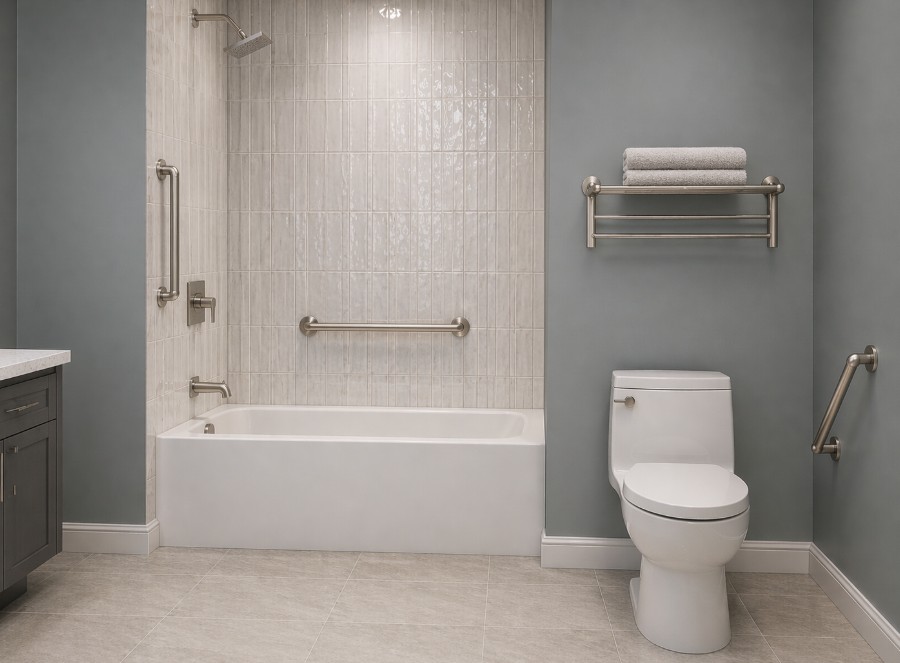
Grab Bar Installation Guide
If you are thinking about installing grab bars in your home, the first question is usually not about the bar itself.
It is where it should go, how it should be installed, and whether it will actually provide support when it matters.
Most people are not trying to make a bathroom look clinical. They are trying to make it safer without overdoing it or getting it wrong.
This guide walks through what actually matters based on real installations, including grab bar placement, how they should be secured, and what types of grab bars work best.
Where should grab bars be installed?
This is the most important part of any grab bar installation.
If placement is wrong, even a well-installed bar will not help much.
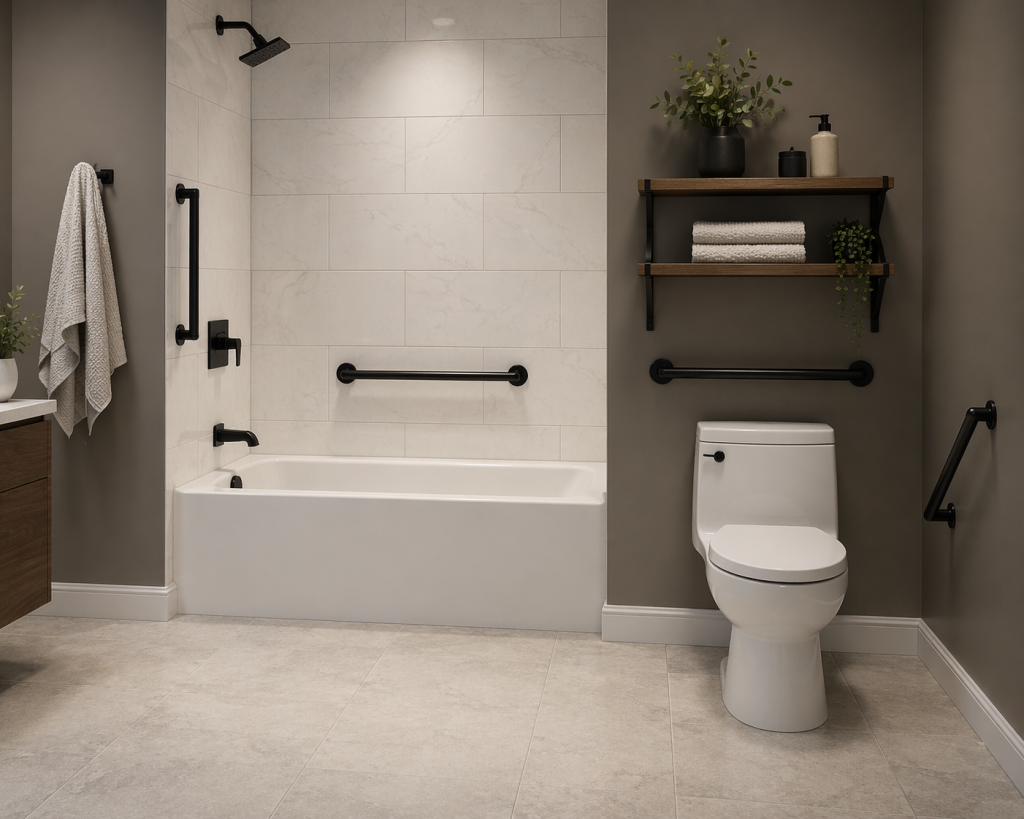
This shows the main support points in a typical bathroom. You do not need all of them in every home, but most safe setups include at least two.
Entry / vertical grab bar
One of the most useful placements is a vertical grab bar at the entry of the tub or shower.
This is where people often feel the most unstable, stepping over the edge while shifting their weight.
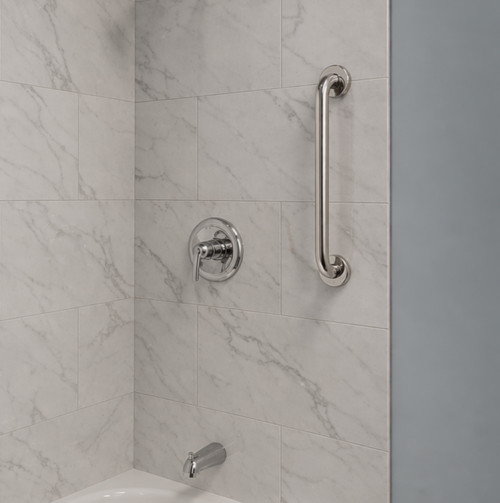
A vertical bar gives a natural grip when stepping in or out and works well for people of different heights.
Back wall grab bar
Another common placement is a horizontal grab bar along the back wall of the tub or shower.
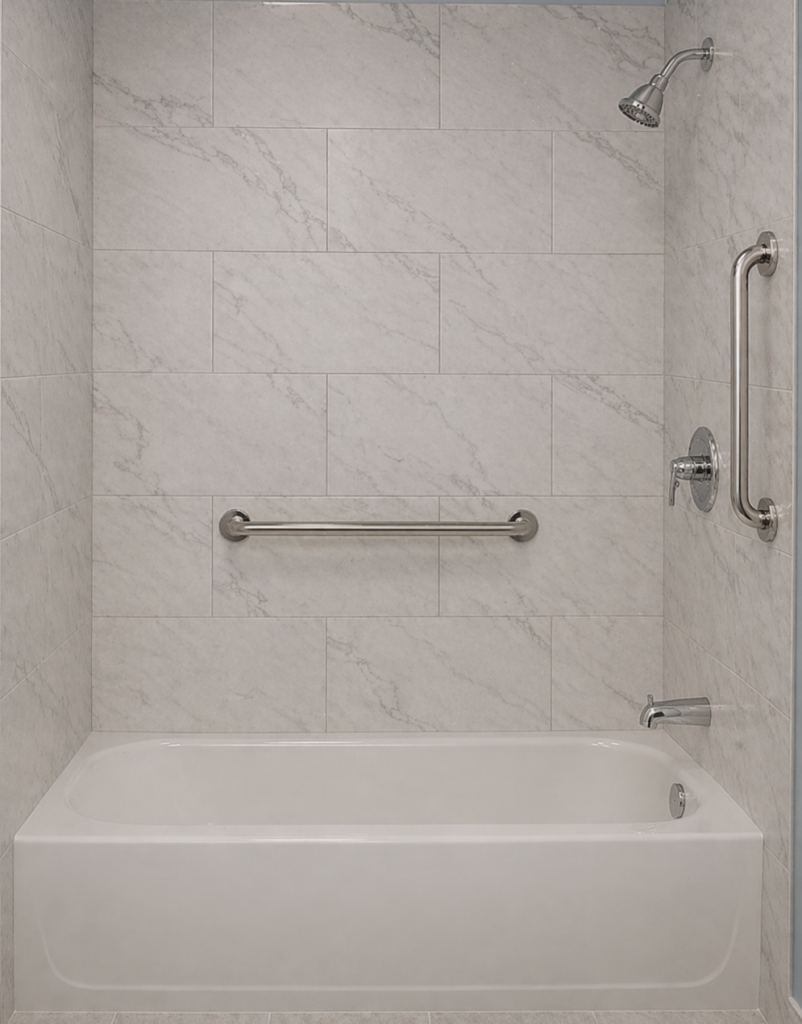
People often ask where to hold on while standing or turning in the shower. This is usually the answer.
It provides:
- balance while standing
- support when shifting position
- a stable reference point in a slippery space
What about beside the toilet?
Grab bars beside the toilet are also very common.
They help with:
- sitting down
- standing up
- maintaining balance
In some cases, a fixed bar works well. In others, a fold-down support bar makes more sense depending on space.
What is the correct height for grab bars?
A common question is: What height should grab bars be installed at?
There are general ranges, but the correct height depends on the person using them.
In most cases:
- bars are installed roughly 33–36 inches from the floor
- but this can vary depending on height, mobility, and how the bar will be used
What matters more than exact height is:
- whether the bar can be reached naturally
- whether it supports the movement it is meant for
Do grab bars need to be installed into studs?
This is one of the most searched questions.
Yes, ideally grab bars are installed into studs.
That is the most secure method and provides the highest load capacity.
But in real homes, that is not always possible.
In those cases:
- specialized anchors
- secure mounting systems
- proper installation techniques
can still create a safe, load-bearing installation.
The key is not just what you attach to, but how well the bar is secured to the wall system as a whole.
Can grab bars be installed on tile or drywall?
Yes, but this is where things often go wrong.
Installing grab bars on tile requires:
- proper drilling technique
- the right bits
- careful handling to avoid cracking
Behind the tile, the structure matters even more.
On drywall, the question becomes:
- what is behind it
- and how the load is distributed
This is why many people decide not to treat grab bar installation as a simple DIY job.
What are the best grab bars for seniors?
Another common question is: What type of grab bar is best?
There is no single answer. It depends on the situation.
Some common types include:
- Straight bars
Simple, strong, and versatile - Angled bars
Helpful for transitions, especially near entries - Double bars or bars with integrated rails
Provide additional grip options - Fold-down support bars
Useful beside toilets where space is limited - Bars with shelves or accessories
Combine function with convenience
The best grab bars for seniors are the ones that:
- match how the space is used
- feel natural to grab
- and are installed securely
If you are also thinking about how they look, you can see more options in grab bars that look good and actually make your home better.
Are suction grab bars safe?
This comes up often.
Suction grab bars can be useful for:
- light support
- temporary positioning
But they should not be relied on for full body weight.
For real safety, permanently installed grab bars are the standard.
Should you install grab bars yourself or hire someone?
Some installations are straightforward. Others are not.
The risk is not just that the bar comes loose. It is that it gives a false sense of security.
A properly installed grab bar should:
- feel completely solid
- support full weight without movement
- be placed exactly where it is needed
That is why many people choose professional grab bar installation, especially when tile, anchors, or placement decisions are involved.
If you are wondering about pricing, you can see a full breakdown in grab bar installation cost Toronto.
When to involve an occupational therapist
In some situations, it is worth going beyond general guidance.
If someone is recovering from an injury, managing a condition that affects balance or strength, or having increasing difficulty with everyday movement, an occupational therapist can provide very specific recommendations.
They look at how a person actually moves through their home and identify where support is needed, including exact grab bar placement, height, and configuration.
When that kind of clinical input is available, it should guide the installation.
In many homes, simple and well-placed grab bars are enough. In others, a more tailored approach makes a meaningful difference in safety and confidence.
Final guidance
Grab bars are one of the simplest ways to make a bathroom safer, but only if they are:
- placed correctly
- installed securely
- matched to how the space is used
Most homes do not need a complicated setup. They need a few well-placed supports that work reliably every time.
If you want help planning or installing grab bars in your home, you can learn more about grab bar installation Toronto and how the process works.