
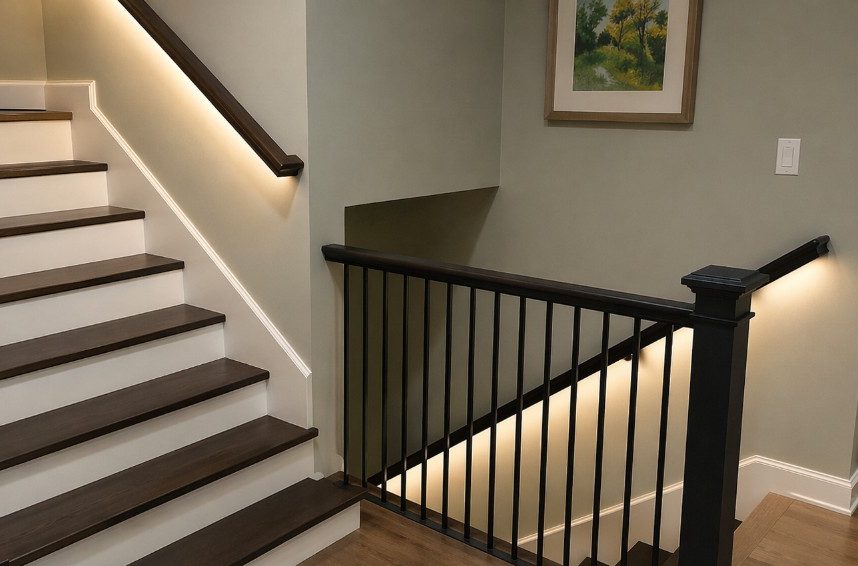
Poor lighting is one of the most overlooked risks in the home.
It’s not usually obvious during the day. But at night, or in low light, small things become hazards. A shadow on the stairs. A dark hallway. A missed step near the bathroom.
This is where home safety lighting for seniors becomes one of the most effective and affordable improvements you can make.
In homes across Toronto, North York, Vaughan, and Richmond Hill, we often see the same lighting gaps. The good news is that fixing them usually does not require major renovations.
Where Home Safety Lighting Matters Most (Stairs, Hallways, Bathrooms)
Stairs
Stairs are one of the highest-risk areas in any home.
Key improvements:
- Step lights or strip lighting for consistent visibility
- Lighting at both the top and bottom of the staircase
- Motion-activated lighting for nighttime use
Even a simple upgrade can reduce hesitation and improve confidence.
Hallways and Pathways
Hallways often feel fine during the day, but become difficult to navigate at night.
Helpful upgrades:
- Plug-in night lights with soft, continuous illumination
- Motion sensor lights that activate automatically
- Consistent lighting along longer pathways
The goal is not brightness. It is clear, predictable visibility without glare.
Bathrooms
Many falls happen during nighttime trips to the bathroom.
Practical options:
- Motion-activated lights near the entrance
- Soft under-cabinet or toe-kick lighting
- Better overhead lighting without harsh shadows
These changes remove uncertainty in a high-risk moment.
Entryways and Exterior Paths
Lighting should start before you even enter the home.
Important areas:
- Front steps and railings
- Walkways and driveways
- Garage-to-home transitions
Low-voltage lighting works especially well here. It provides steady, reliable illumination without being overpowering.
Motion Sensor Lights and Night Lighting for Seniors
Some of the most effective home safety lighting upgrades are also the simplest.
- Motion sensor lights turn on automatically
- Night lights provide consistent low-level illumination
- Battery or plug-in options avoid the need for wiring
These are ideal for:
- Bedrooms to bathrooms
- Hallways
- Basements
- Stair landings
They reduce the need to search for switches and make movement feel more natural.
Low Voltage Lighting for Safer Homes
Low-voltage systems (typically 12V or 24V) are one of the most practical solutions for home safety lighting.
They are:
- Energy efficient
- Safer to install and maintain
- Ideal for continuous lighting along stairs and walkways
This type of lighting works best when you want subtle, always-on visibility without harsh glare.
When Simple Lighting Fixes Are Enough and When They’re Not
Many safety lighting upgrades can be done without major electrical work.
For example:
- Plug-in lights
- Battery-powered motion lights
- Replacing bulbs or fixtures
But some situations require:
- New wiring
- Additional switches
- Outdoor electrical connections
When that happens, a licensed electrician is required.
How We Handle Home Safety Lighting at Good Company
At Good Company, we focus on practical, safety-first lighting improvements.
Our trained, insured team can help with:
- Installing motion lights and night lighting
- Replacing or upgrading existing fixtures
- Setting up low-voltage indoor and outdoor lighting
- Mounting plug-in or battery-powered lighting
- Improving lighting using existing wiring
When electrical work is needed, we coordinate with trusted electricians so everything is done properly.
You get the right level of work without unnecessary complexity.
If you are looking for more design-focused or fixture upgrades, you can visit our
https://goodcompanyhome.com/light-fixture-installation/
For broader projects, see our
https://goodcompanyhome.com/installation-services-toronto/
And for a complete overview, read our guide to
https://goodcompanyhome.com/home-lighting-installation-toronto/
Why Home Safety Lighting Matters
Lighting upgrades are one of the simplest ways to improve safety at home.
They:
- Reduce fall risk
- Improve confidence
- Make everyday movement easier
- Support aging in place
Most importantly, they address risks before something happens.
Frequently Asked Questions About Home Safety Lighting
What is the best lighting for stairs to prevent falls?
The best stair lighting provides consistent, glare-free visibility. Step lights, LED strips, and motion-activated lights are all effective options, especially when combined with lighting at the top and bottom of the stairs.
Are motion sensor lights good for seniors?
Yes. Motion sensor lights are one of the most effective safety upgrades because they turn on automatically and eliminate the need to find switches in the dark.
Where should night lights be placed in a home?
Night lights are most useful along pathways, especially between bedrooms and bathrooms, in hallways, and near stairs or entry points.
Is low voltage lighting safe for indoor use?
Yes. Low-voltage lighting (12V or 24V) is commonly used for indoor and outdoor safety applications. It is energy efficient and well suited for continuous lighting along stairs and walkways.
How much does it cost to improve home safety lighting?
Costs vary depending on the type of upgrade. Many simple solutions, like plug-in or motion lights, are inexpensive. More involved installations, such as low-voltage systems or fixture upgrades, depend on layout and wiring.
A Quick Note
This article is intended as general guidance. Every home is different, and the right solution depends on layout, lighting conditions, and individual needs.
Practical Help, Right at Home
If your home feels just a little too dark or harder to navigate than it used to, it is worth paying attention to that.
We’re always happy to take a look and suggest simple, effective improvements.
To schedule a lighting safety check in Toronto, North York, Vaughan, or Richmond Hill, call 416-894-1137 or visit goodcompanyhome.com.
Reliable help. Right at home.
About the Author
Jesse Black-Allen is the founder of Good Company, a North York-based home safety and accessibility specialist serving Toronto, Vaughan, and Richmond Hill. He helps families and homeowners improve safety, functionality, and peace of mind through practical home assessments and professional installation support.