
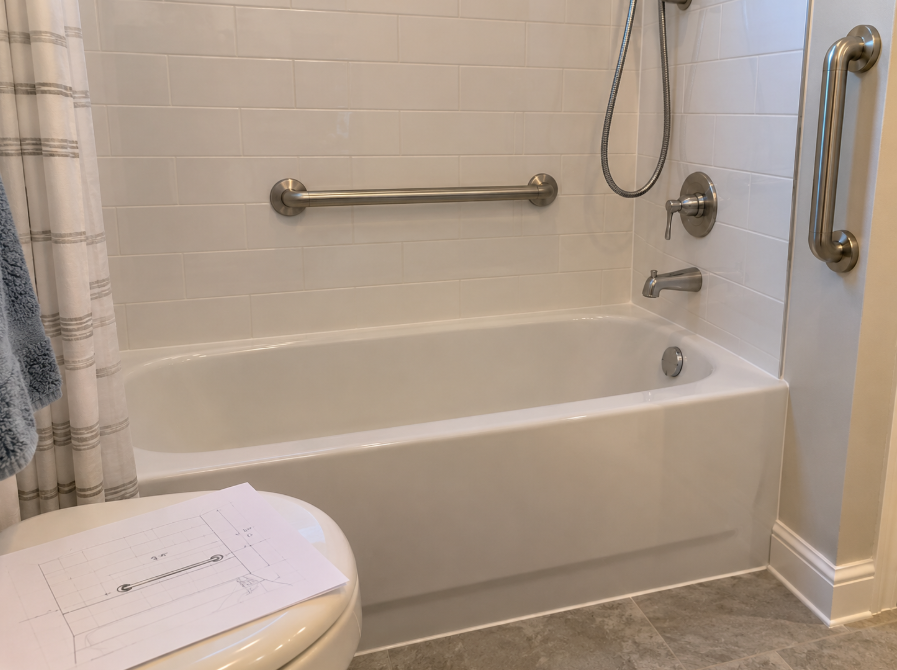
When an occupational therapist or other health professional recommends changes to a client’s home, Good Company’s role is to turn those recommendations into safe, practical, professionally completed work.
That requires more than good installation.
It requires an accountable contractor, respect for professional guidance, thoughtful communication, responsiveness when timelines are tight, and sensitivity to the person whose home is being changed.
Good Company works directly with clients and families and regularly carries out recommendations from occupational therapists and other health professionals. Our aim is to make the implementation side of home accessibility as straightforward and dependable as possible.
What professionals and clients can expect from Good Company
| What matters | The Good Company approach |
|---|---|
| Accountability | Public ownership information, City of Toronto Building Renovator licensing, commercial liability insurance, WSIB coverage, written quotes and invoices, public client reviews and workmanship warranty protection. |
| Respect for professional guidance | Recommendations are taken seriously, particularly where placement, equipment or design relates to the client’s function. |
| Responsibility for our work | Good Company takes responsibility for construction methods, fastening, installation quality and workmanship. |
| Client-centred service | The client’s preferences, dignity, budget and right to make decisions about their own home remain central. |
| Responsive service | Accessibility and discharge work is often time-sensitive. We make a serious effort to accommodate urgent needs without compromising the quality of the work. |
| Choice and flexibility | Where safety and timing allow, clients can choose among suitable products, finishes and approaches rather than being limited to whatever is immediately available. |
| Communication | We keep clients, families and involved professionals informed when it helps the project move forward or when site conditions affect a recommendation. |
| Documentation | We maintain appropriate records of scope, products, site conditions, installation and completion. |
| Privacy | We seek the information necessary to carry out the work properly, not unnecessary medical information. |
| Transparency | Clients should know who is doing the work, who is responsible for it and when another trade or specialist is involved. |
These principles apply whether Good Company is contacted by a health professional, by a client directly, or by a family trying to prepare a home for someone’s return.
Different expertise, one client
Home accessibility work often brings together several kinds of expertise.
An occupational therapist may understand how a particular person transfers, reaches, balances, bathes, uses stairs, manages equipment or moves through the home in ways that are not obvious from simply looking at the building.
That expertise is valuable.
Ontario Health atHome describes occupational therapists as regulated health professionals who assess people’s abilities in relation to everyday activities and their environment and may recommend accessibility changes, assistive devices and other strategies for living safely and independently at home. Ontario Health atHome explains occupational therapy services here.
Good Company brings the construction and installation expertise needed to make those recommendations work in the actual home.
That includes understanding framing, concrete, masonry, tile, plumbing, fastening systems, railings, bathrooms, entrances, ramps, product requirements and the limitations that inevitably arise in existing buildings.
The Canadian Association of Occupational Therapists describes home modification as collaborative work that can involve occupational therapists alongside contractors, builders, designers, suppliers and other participants.
That collaborative model makes sense to us.
The health professional brings knowledge of the person and their functional needs. Good Company brings knowledge of how to alter the physical environment safely and effectively. The client and family bring their own priorities, experience and understanding of daily life.
Good work respects all three.
Respecting professional recommendations
When an OT or another health professional has made a recommendation, we want to understand it properly before we act on it.
Sometimes the recommendation is broad: improve stair safety, provide bathroom support, address toilet height or make an entrance easier to use.
Sometimes it is very specific because the location, orientation, height or type of equipment is important to the way that particular client functions.
We do not treat those two situations as though they are the same.
If an OT has identified a specific grab-bar position because of the way a client transfers, we do not casually move it because another location would be easier to install.
At the same time, installation decisions are part of our responsibility as the contractor.
If a recommended grab-bar location does not line up neatly with conventional framing, our first job is to determine whether there is another safe and appropriate way to install it.
If the available construction solution would require changing the location enough that the client may no longer be able to use the bar as intended, the installation issue has begun to affect the functional recommendation.
That is when communication matters.
Good collaboration does not mean turning every installation decision into a clinical decision. It means recognizing when an installation decision could affect the purpose of the professional recommendation.
The College of Occupational Therapists of Ontario specifically recognizes recommendations to building contractors about home modifications as a legitimate consulting relationship. COTO’s guidance is available here.
Clear roles create clear accountability
When Good Company accepts a project, we take responsibility for the work that belongs to us.
That includes:
- assessing actual site conditions;
- selecting appropriate construction and fastening methods;
- following relevant manufacturer requirements;
- protecting existing finishes;
- identifying conditions that make a proposed installation unsafe or impractical;
- completing the work carefully;
- documenting unusual conditions where appropriate;
- standing behind our workmanship.
A health professional should not have to become an expert in anchors, fasteners, tile drilling or waterproofing in order to recommend a home modification.
COTO’s guidance is helpful on this point. When an occupational therapist acts as a consultant and provides recommendations to another professional or contractor, the OT remains accountable for the recommendation, but not for the person carrying out that recommendation or for the quality of that person’s service.
That distinction allows each professional to concentrate on their own area of competence.
For Good Company, it also means that we do not look to a referring professional to approve our construction methods or absorb responsibility for our workmanship.
Accountability begins before the work starts
A professional who recommends a contractor is placing a degree of trust in that business.
Good Company tries to make that trust verifiable.
Our ownership is public. Jesse Black-Allen is Good Company’s owner and the person responsible for the business.
Good Company maintains a City of Toronto Building Renovator licence, commercial liability insurance and WSIB coverage. We provide written quotes and invoices, maintain public client reviews, document work where appropriate and provide workmanship warranty protection.
Good Company is also listed in the Canadian Home Builders’ Association public member directory.
Public reviews matter because they allow families and referring professionals to see what previous customers have actually said about their experience. Click here to see Good Company’s reviews.
They are one part of a broader picture of accountability that also includes licensing, insurance, an identifiable owner and a clear business history.
Some projects require another trade or specialist. When that happens, clients should understand who is involved and why.
Transparency should not end simply because more than one person is required to complete the work.
Client choice is part of a good result
Safety is fundamental to accessibility work.
So are dignity, usability and the client’s sense that the home still belongs to them.
People care about how their homes look. They care about cost, convenience, disruption, product quality and whether a new modification works visually as well as functionally.
Good Company respects that.
Consider someone returning from rehabilitation to a bathroom that was recently renovated.
Their OT may quite properly recommend several grab bars.
The client may also care very much whether those bars match the fixtures, whether the mounting flanges are concealed or whether a particular finish is available.
That is a reasonable concern.
Good Company works with products from reputable manufacturers and, where the client’s needs and timeline permit, we are happy to help source different sizes, finishes and styles or facilitate special orders.
The same principle can apply to handrails, bathroom equipment and larger accessibility modifications.
Sometimes the priority is speed and an appropriate product needs to be installed before the client comes home tomorrow.
Other times there is enough time to order the product or finish the client actually wants.
We explain the options.
The goal is a result that is safe and durable, but also one the client can feel comfortable living with.
Respecting autonomy during a period of change
Home modifications often happen at a difficult point in someone’s life.
A person may be adjusting to an injury, illness or change in mobility while family members and health professionals are simultaneously discussing what needs to change at home.
It is easy for the individual to feel that decisions are being made around them.
Good Company tries not to add to that.
COTO’s current Code of Ethics places respect for autonomy alongside accountability, collaboration, integrity, respect and transparency.
Those principles are equally useful in thinking about the contractor’s role.
The professional recommendation matters.
Family concerns matter.
Our own safety and construction obligations matter.
And the person whose home is being modified remains someone with preferences, priorities, a budget and the right to participate meaningfully in decisions.
Responsive without being rushed
Accessibility and hospital-discharge work can move quickly.
A discharge date may change.
A family may find out late that equipment does not fit.
A railing or bathroom modification that could normally wait may suddenly become essential.
Good Company makes a serious effort to accommodate those realities.
Ontario Health’s 2026 Transitions Between Hospital and Home quality standard recognizes that hospital-to-home transitions are complex and that breakdowns in coordination can cause harm through both errors and delays. It emphasizes planning, communication, equipment needs, home and community supports, and meaningful involvement of patients and families. Ontario Health’s transition standard is available here.
Our approach is simple:
Move quickly when the situation requires it, without shortening the steps necessary for safe, durable work.
Sometimes that means installing an appropriate product immediately.
Sometimes it means finding an interim solution while a preferred permanent product is ordered.
Sometimes it means contacting the OT or another professional because an unexpected condition materially affects the recommendation.
The right response depends on the client and the situation.
Hospital discharge does not always happen neatly
The ideal discharge process identifies home needs early and has everything ready before the client arrives.
Real life can be much less orderly.
A family may have a detailed OT report.
They may have partial verbal instructions.
Equipment may have been recommended but not purchased.
A family member may be arranging grab bars, railings, transportation, prescriptions and meals all at once.
Good Company tries to reduce that burden.
When professional recommendations are available, we work from them.
If something important is unclear, we ask.
If a problem falls within our own expertise, we solve it.
And where possible, we try to identify predictable practical issues before the client comes home.
Looking at the home, not only the work order
Experience in home accessibility means paying attention to the environment around the immediate installation.
Suppose a family contacts Good Company to install the bathroom grab bars recommended before their father returns from rehabilitation.
While we are there, we notice that the stairs he will need to use have no handrail.
Or the family mentions that he will need to shower seated but there is no handheld shower head.
Or they have not yet obtained the toilet equipment they were expecting to have before discharge.
It may be helpful to raise those issues.
That does not mean diagnosing the client, changing the care plan or assuming that every observation requires another sale.
Often the appropriate response is simply:
“You may want to bring this up with him and with his OT or care team before discharge.”
A small amount of foresight can prevent considerable stress and expense later.
This is one of the advantages of having a contractor who understands that accessibility work is part of a larger home environment rather than a series of isolated installations.
Communication that helps the client
Good Company welcomes communication with occupational therapists and other health professionals.
Depending on the project, that may involve:
- receiving a written recommendation;
- confirming a location or measurement;
- clarifying an instruction;
- identifying a site condition that affects the recommendation;
- discussing a practical alternative;
- confirming that work has been completed;
- sharing relevant completion photographs.
The purpose of communication is to help produce a good result for the client.
We do not believe that every construction detail needs to be circulated simply because it exists.
Likewise, Good Company usually does not need a person’s complete medical history.
The right information should reach the right people.
Documentation and privacy
Good Company maintains appropriate records because documentation supports quality and accountability.
Depending on the project, those records may include:
- the agreed scope;
- relevant professional recommendations;
- products supplied;
- measurements;
- photographs;
- significant site conditions;
- installation information;
- changes from the original plan;
- invoices, completion information and warranty details.
Some of that information may be useful to the OT or other professional. Some appropriately remains part of our own job record.
The purpose is to make the work traceable and responsibilities clear.
Privacy matters as well.
COTO’s Standard for Consent emphasizes informed consent and limiting the collection and disclosure of personal health information to what is needed.
That approach makes practical sense to us.
If a particular placement is important because of the way the client transfers, that may be useful information.
A detailed unrelated medical history probably is not.
Families and care partners
Family members and other care partners are often essential to making home modifications happen.
An adult child may be arranging the work.
A spouse may be preparing the home.
One person may be communicating with the hospital while another is purchasing equipment.
Good Company welcomes that involvement when the client wants those people included.
Often the strongest result comes from bringing together:
the health professional’s understanding of function,
the contractor’s understanding of the home,
the family’s understanding of everyday circumstances,
and the client’s own priorities and preferences.
Professional referrals should be based on trust
Good Company does not pay health professionals for referrals and does not expect exclusive referral relationships.
COTO’s conflict-of-interest standard prohibits occupational therapists from giving or receiving incentives in exchange for client referrals.
A professional should feel comfortable identifying Good Company as a resource because they believe we may serve the client well.
The client remains free to choose another contractor, supplier or solution.
What health professionals can expect from Good Company
When a health professional suggests Good Company to a client or family, we want that referral to be easy to stand behind.
They can expect:
An accountable contractor.
Public ownership, licensing, insurance, WSIB coverage, public reviews and a clear person responsible for the business.
Respect for professional guidance.
We recognize that recommendations may have functional reasons that are not apparent from the building alone.
Strong installation standards.
We take responsibility for construction methods, product installation and workmanship.
Responsive service.
We understand the time pressures associated with discharge, rehabilitation and changing mobility.
Practical judgment.
We solve ordinary construction problems ourselves and communicate when a site condition affects the purpose of a recommendation.
Client choice and flexibility.
Where appropriate, we provide meaningful product, finish and design options rather than treating accessibility equipment as one-size-fits-all.
Awareness of the larger home environment.
If we notice something that may create a practical problem for the client, we raise it thoughtfully.
Clear communication.
We keep clients, families and professionals appropriately informed.
Useful documentation.
We maintain records that support quality and accountability.
Respect for privacy.
We ask for the information needed to do the work properly, not more.
Kindness and patience.
Many accessibility projects happen during stressful periods. Professional service includes understanding that.
A relationship built around the client
Good Company wants to be the kind of contractor that occupational therapists and other health professionals can comfortably identify as a resource for their clients.
That requires technical competence, but it also requires judgment, responsiveness, communication and respect.
The health professional should be able to concentrate on the work that belongs to their profession.
Good Company should take full responsibility for the work that belongs to ours.
The family should be able to participate constructively.
And the client should remain at the centre of the decisions being made about their own home.
The result we are working toward is not simply a completed installation. It is a safer, more functional home—and a client who still feels that it is their home.
Working with Good Company
Good Company provides grab-bar installation, handrails, post-discharge home setup, bathroom accessibility work, ramps and other accessibility modifications in Toronto, North York, Vaughan, Richmond Hill and surrounding areas.
Occupational therapists and other health professionals are welcome to contact Good Company about a client’s project with the client’s permission.
Clients and families can also contact us directly with an OT report, discharge recommendation or other professional guidance.
We will review what has been recommended, assess the practical requirements of the home and help turn the recommendation into a completed solution.