
What Are the Main Ways to Raise a Toilet?
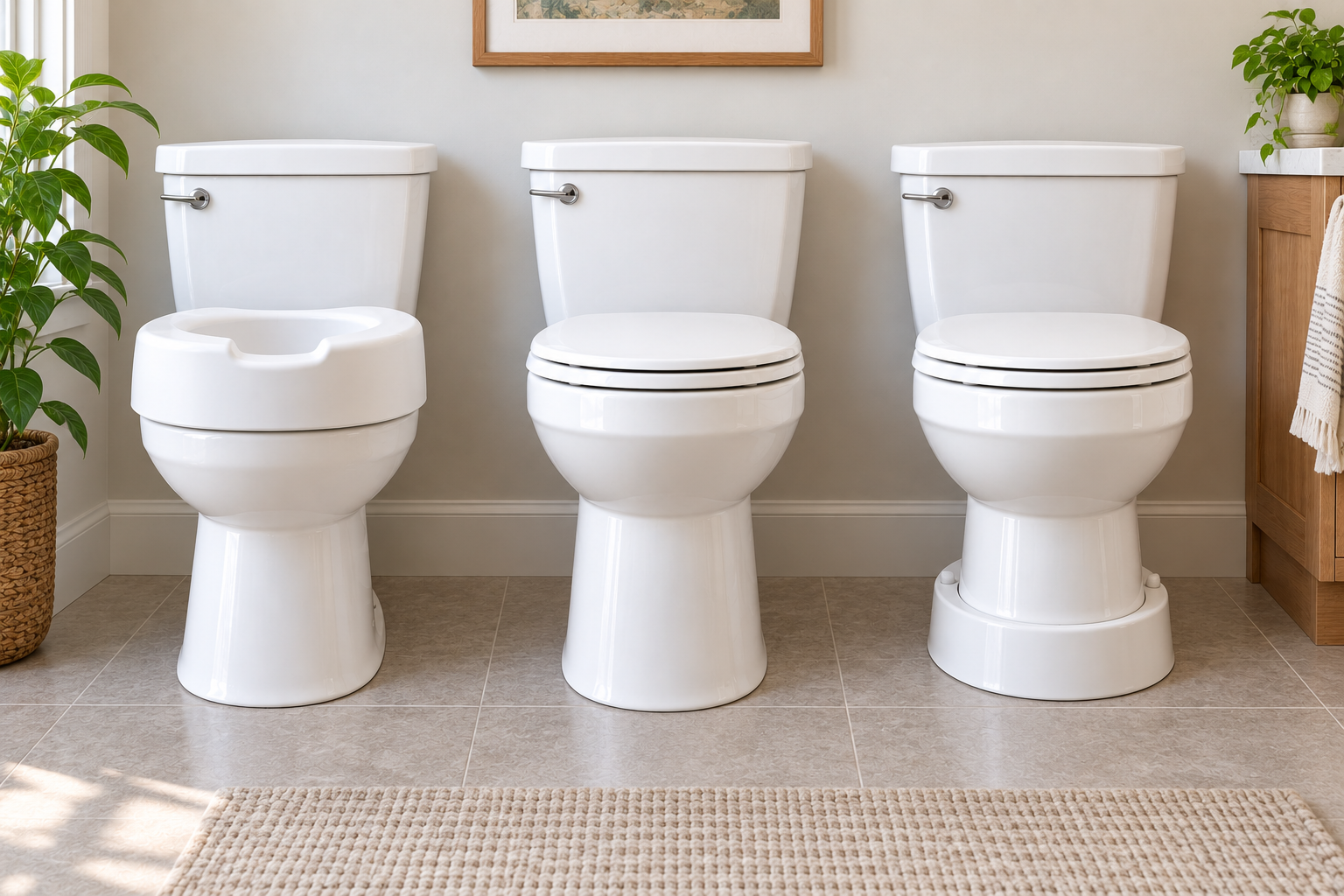
If your toilet is too low, there are three main ways to make it higher:
- Add a raised toilet seat or toilet seat riser
- Replace the toilet with a taller, comfort-height or chair-height toilet
- Raise the entire existing toilet with an under-toilet riser, such as a Toilevator
All three can work well. The best choice depends on why the toilet needs to be higher, how much additional height is needed, whether the change is temporary or permanent, and, importantly, the toilet you already have.
I install bathroom safety and accessibility equipment in homes around Toronto, and one thing I have learned is that toilet raising can be more complicated than it first appears. People often assume they can simply buy a raised toilet seat from a medical supply store, bring it home and put it on. Sometimes that is exactly what happens. Other times, a product that looks right on the box will not fit the toilet properly, will not work with the existing toilet seat, or will create another problem that nobody considered.
Before choosing a product, it helps to understand the three basic approaches.
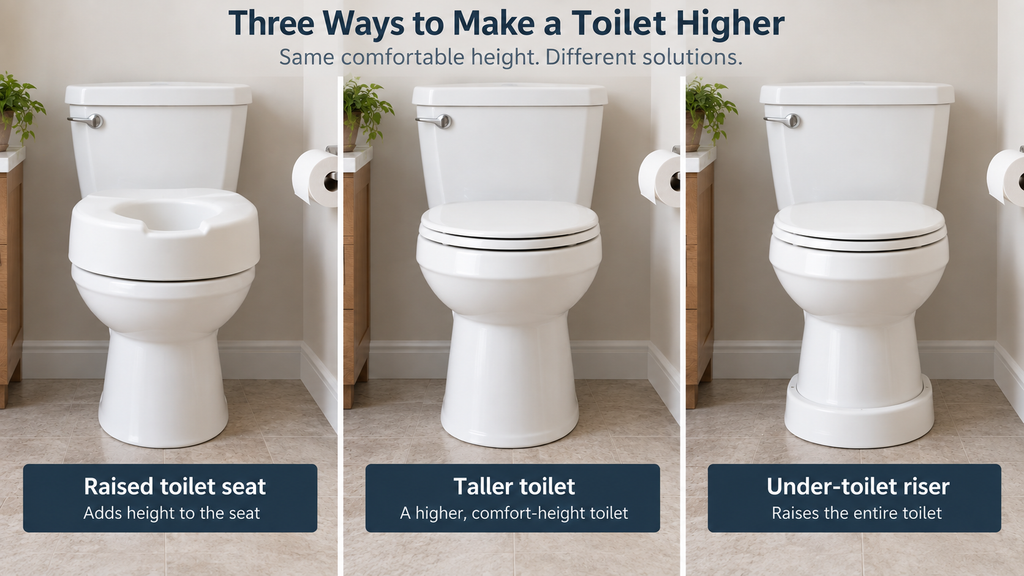
How to Make a Toilet Higher: Toilet-Raising Options at a Glance
| Raised toilet seat | New taller toilet | Under-toilet riser | |
|---|---|---|---|
| What gets raised? | The sitting surface | The entire toilet is replaced | The entire existing toilet |
| Keep your existing toilet? | Yes | No | Yes |
| Typical appearance | Accessibility device is visible | Looks like a normal toilet | Existing toilet looks largely unchanged |
| Easy to remove later? | Often | No | Requires removing and resetting the toilet |
| Uses a normal toilet seat? | Depends on the riser and seat | Yes | Usually yes |
| Compatibility concerns | Bowl shape, round vs. elongated, mounting system, seat, surrounding space | Rough-in, bathroom space and desired height | Toilet footprint and mounting system |
| Good for temporary use? | Often very good | Usually not the first choice | Possible, but more involved |
| Good for a permanent solution? | Sometimes | Yes | Yes |
| Installation difficulty | From very simple to surprisingly tricky | Toilet replacement | Toilet removal and reinstallation |
| Worth considering when… | You want an economical or removable option | The existing toilet could use replacing anyway | You like the existing toilet but want a more integrated way to raise it |
Start by Measuring the Toilet You Already Have
Before deciding whether you need a 2-inch, 3½-inch or 4-inch toilet riser, find out where you are starting.
Measure from the finished floor to the top of the existing toilet seat.
That sounds obvious, but it is often skipped. Adding 3½ inches does not produce one universal final toilet height. A 3½-inch riser on a particularly low toilet will give a very different result from the same riser on a toilet that is already relatively tall.
Where there is a recommendation from an occupational therapist, physiotherapist or another medical professional, that should be part of the decision.
I also hear another surprisingly useful reference point from people returning home from hospital:
“I want my toilet to be about the same height as the one I was using in the hospital.”
That makes sense. If someone has spent days or weeks getting accustomed to sitting and standing at a particular height, reproducing something similar at home may be more useful than simply buying a product because its packaging says “3½-inch riser.”
If possible, find out the hospital toilet height before coming home.
Option 1: Add a Raised Toilet Seat
Raised toilet seats are probably the first solution most people encounter. They are widely available at medical supply stores, relatively inexpensive, and many can be installed without changing the toilet itself.
They can be an excellent choice, particularly when the need may be temporary.
They are also where I see the most compatibility problems.
Round versus elongated is only the beginning
Most people buying a toilet seat riser know to check whether their toilet is round or elongated. Medical supply stores are generally very good about bringing this distinction to people’s attention.
Unfortunately, that does not guarantee that the riser will fit.
There are several other things I would check.
The actual shape of the toilet bowl matters
Two elongated toilets can have very different shapes.
The porcelain may flare outward near the rear of the bowl. The area around the toilet seat mounting holes may be unusually sculpted. Some toilets are skirted or have very little accessible porcelain for a clamp-style riser to grip.
This becomes particularly noticeable with products advertised as universal raised toilet seats.
A universal design can accommodate a wide range of toilets, but “universal” should not be interpreted to mean literally every toilet.
I run into this with TOTO toilets fairly often in Toronto. TOTO makes very good toilets, but some of their bowl and mounting designs can be frustrating when you are trying to add aftermarket accessibility equipment. A side-clamping riser that works perfectly on a conventional bowl may have nowhere suitable to clamp when the porcelain flares out in an unexpected place.
This is one reason I would never assess a toilet riser from the words “round” or “elongated” alone.
Check the toilet seat too
This is one of the most easily overlooked compatibility issues.
The riser can fit the toilet perfectly and the existing toilet seat can still be incompatible with the riser.
Many newer toilets have quick-release or easy-off seats. Others use unusual mounting hardware. A conventional riser may expect the toilet seat to be attached to the riser using long bolts in a fairly traditional arrangement.
If your existing seat uses a different fastening system, you can discover after opening the package that the riser fits the bowl but your seat cannot be properly reattached.
I see this often enough that I now consider the toilet seat part of the compatibility check, not an afterthought.
Before buying a riser, look at:
- whether the toilet is round or elongated
- the shape of the porcelain around the bowl
- the distance between the toilet seat mounting holes
- how the existing toilet seat attaches
- whether the riser requires a particular type of toilet seat
- the available space around the toilet
That last point can create another surprise.
Do the Handles Actually Fit Beside the Toilet?
Many raised toilet seats come with arms, or are used together with a toilet safety frame.
Before buying one, measure the available width.
A wall or bathroom vanity can make an otherwise suitable product too wide for the space. Even a toilet paper holder can interfere with the arms.
I see the toilet paper holder problem quite regularly. Fortunately, a toilet paper holder can usually be relocated. A wall or cabinet cannot.
This is a small detail, but it illustrates why choosing bathroom accessibility equipment based only on the dimensions of the toilet itself can cause problems.
What About “Universal” Clamp-On Risers?
Some raised toilet seats do not use the toilet’s existing bolt holes at all. Instead, they sit over the bowl and are secured using clamps or an adjustment mechanism.
The advantage is obvious. They can fit toilets that would otherwise be difficult to accommodate.
The tradeoff is that different attachment systems feel and behave differently.
I have installed products that were fitted exactly according to the manufacturer’s instructions but where I was still less enthusiastic about the overall setup than I would have been with a more positively attached product. This is particularly worth thinking about when a raised seat also has substantial handles attached to it.
That does not mean an entire class of products is unsuitable. It does mean that “it fits” and “this is the solution I would choose for this person” are not always the same question.
The user’s balance, mobility, how they transfer on and off the toilet, and how they intend to use the handles all matter.
Removability Can Be a Major Advantage
There is another reason conventional toilet risers remain popular: people often want to be able to take them off.
Someone recovering from surgery may expect to need a higher toilet for several weeks or months rather than permanently.
Others simply do not want their bathroom to look medical. I have encountered people who use accessibility equipment every day but prefer to remove it when guests are visiting.
For those situations, a removable raised seat paired with a freestanding toilet safety frame can be attractive. The equipment can be assembled and set up without permanently changing the toilet.
So despite the compatibility headaches, there are plenty of situations where a conventional raised toilet seat remains the right answer.
Option 2: Replace the Toilet With a Taller Toilet
The second approach is to stop adapting the existing toilet and replace it.
Depending on the manufacturer, you will see terms such as:
- comfort-height toilet
- chair-height toilet
- tall toilet
- accessible-height toilet
- universal-height toilet
These terms are useful when shopping, but I would still look at the actual seat height of the specific model rather than relying entirely on the label.
A taller toilet can be an excellent permanent solution.
It looks like an ordinary toilet because it is an ordinary toilet. There is no raised seat sitting on top, there are fewer compatibility questions involving the toilet seat, and there is nothing to remove or reinstall every time someone wants the bathroom returned to its original appearance.
If the existing toilet is old, unreliable or due for replacement anyway, a taller toilet may make considerably more sense than spending money adapting it.
There is one important limitation, however.
A taller toilet only gets you to the height that particular toilet provides.
If someone needs substantially more height than a typical chair-height toilet provides, replacement alone may not solve the problem. And if the existing toilet is otherwise excellent, replacing the whole fixture simply to gain a few inches can feel wasteful.
That leads to the third option.
Option 3: Raise the Entire Existing Toilet
Instead of raising the seat or replacing the toilet, it is also possible to raise the whole toilet.
This is a less familiar option, but an interesting one.
One product designed specifically for this purpose is the Toilevator by Hartmobility. It installs beneath the toilet and raises the entire fixture approximately 3½ inches.
The toilet is removed, the riser is installed at floor level, and the toilet is reset on top.
The biggest conceptual difference is that the accessibility modification happens underneath the toilet rather than on top of the bowl.
That solves a number of problems associated with conventional raised seats.
The user can generally keep a normal toilet seat and lid. The shape of the upper bowl is much less important. There is no large raised-seat attachment sitting between the person and the toilet. Visually, the bathroom can also look considerably less medical.
For someone who likes their existing toilet but needs it higher, this can be a very appealing middle ground between a raised seat and complete toilet replacement.
It still isn’t literally universal
An under-toilet riser avoids many upper-bowl compatibility problems, but you still have to look at the bottom of the toilet.
The footprint of the toilet base needs to fit the riser. Unusually large skirted toilets need to be checked carefully. Some toilets also use non-standard mounting systems.
TOTO provides a good example again. Certain skirted TOTO toilets use the company’s UniFit mounting system rather than a conventional toilet-to-flange arrangement. That does not automatically mean an under-toilet riser cannot be used, but it does mean compatibility should be confirmed rather than assumed.
So the compatibility question changes.
With a conventional raised toilet seat, you are often asking:
Will this product fit the bowl and seat?
With an under-toilet riser, you are asking:
Will this product accommodate the base and mounting system of the toilet?
For many toilets, the second question may turn out to be much easier.
Do Not Leave the Toilet Until the Last Minute
This is one of the biggest practical lessons I would give families preparing a home for someone’s return from hospital.
The toilet often looks like the easy part.
It is very common to think about grab bars, flooring, stairs, bathing and other obvious accessibility issues first, then assume somebody can simply pick up a raised toilet seat shortly before the person comes home.
Usually that works.
Sometimes it very much does not.
I was involved with one home where significant preparation had been done for an older person’s return from hospital. New flooring had gone in. Bathroom safety work was being done. Grab bars were installed. A number of substantial improvements had been considered.
The toilets had essentially been left until the end.
They turned out to be unusually low European-style toilets with an uncommon mounting configuration. What everyone had assumed would be a quick final item suddenly became a rush to find something that would actually work.
The lesson is not that raised toilet seats are difficult.
The lesson is that you do not know whether they will be easy until you look at the toilet.
If someone is coming home from hospital, check the toilet early enough that there is time to change direction if the first solution is not compatible.
So Which Toilet-Raising Option Is Best?
There is no single answer for every bathroom.
A conventional raised toilet seat often makes sense when:
The change may be temporary, budget matters, the user wants something that can be removed easily, and there is a compatible product that fits the toilet securely.
A taller or comfort-height toilet often makes sense when:
The change is expected to be permanent, the existing toilet could use replacing anyway, appearance is important, and the desired height can be achieved with an available toilet model.
An under-toilet riser may make sense when:
The existing toilet is worth keeping, a more integrated appearance is preferred, conventional raised-seat compatibility has become difficult, or the user wants to retain a normal toilet seat while raising the entire fixture.
The right starting point is not necessarily, “Which toilet riser should I buy?”
A better question is:
“What final toilet height do I need, what toilet do I have now, and which of the three ways of getting there makes the most sense?”
That small change in approach can prevent a lot of wasted time, incompatible equipment and last-minute frustration.
And if you are shopping for a toilet riser yourself, particularly one that cannot be returned once opened for hygienic reasons, it is worth doing the compatibility checks before opening the package.
How can I make a toilet higher?
There are three main ways to make a toilet higher: add a raised toilet seat, replace the toilet with a taller comfort-height or chair-height model, or raise the entire existing toilet with an under-toilet riser.
The best option depends on the height you are trying to achieve, the toilet you already have, whether the change is temporary or permanent, and how important removability and appearance are.
How do I know how much higher my toilet should be?
Start by measuring from the finished floor to the top of the existing toilet seat. Then think about the final sitting height you are trying to achieve rather than simply choosing a 2-inch, 3.5-inch or 4-inch riser.
If an occupational therapist, physiotherapist or other medical professional has recommended a specific setup or height, use that as your starting point. People returning home from hospital will also sometimes know that they were comfortable with the toilet height they used there. If possible, getting that measurement can be useful.
Do raised toilet seats fit every toilet?
No. Round versus elongated is only one compatibility issue.
The shape of the porcelain can matter, especially around the rear of the bowl. Some toilets flare outward or have unusual contours that interfere with clamp-on or so-called universal risers. The mounting-hole spacing and the way the toilet seat attaches can also affect compatibility.
This is one reason it is worth looking closely at the actual toilet before buying a riser.
Can a toilet riser fit the toilet but not the toilet seat?
Yes, and this is an issue that is easy to overlook.
A riser may fit the bowl correctly but still be incompatible with the existing toilet seat. Quick-release and easy-off toilet seats are increasingly common, and some use mounting hardware that does not work well with a riser designed for a conventional bolt-through seat.
Before buying a raised toilet seat, check both the toilet and the seat that will be used with it. Alternatively, many clients have me provide and install a new seat.
Why are some TOTO toilets difficult to fit with raised toilet seats?
Some TOTO toilets have unusual bowl shapes, skirted designs or mounting arrangements that can make aftermarket accessories more difficult to fit.
I encounter TOTO toilets regularly in Toronto, and the issue is not that they are poor-quality toilets. It is that the porcelain geometry and mounting design are sometimes very different from the conventional shapes that universal toilet risers are designed around.
If you have a TOTO or another unusually shaped toilet, it is worth checking compatibility before opening a toilet riser package.
What is an under-toilet riser?
An under-toilet riser raises the entire existing toilet rather than adding height on top of the bowl.
Products such as the Toilevator are installed beneath the toilet. The toilet is removed, the riser is installed at floor level, and the toilet is reset on top.
This approach can be useful when you want to keep the existing toilet and normal toilet seat while avoiding some of the compatibility issues associated with raised toilet seats.
Will an under-toilet riser work with every toilet?
Not necessarily.
An under-toilet riser avoids many problems involving bowl shape and toilet-seat mounting, but the toilet’s base footprint and mounting system still need to be checked.
Large skirted toilets and toilets with unusual mounting systems may require additional compatibility checking. Certain TOTO models, for example, use non-standard mounting arrangements that should not be assumed to work without verification.
Should I get a raised toilet seat or replace the toilet?
A raised toilet seat often makes sense when the need may be temporary, budget is important, or you want something that can be removed easily.
Replacing the toilet with a taller model may be a better choice when the existing toilet is old, the height change is expected to be permanent, or you want the bathroom to retain a conventional appearance without an added accessibility device.
An under-toilet riser provides a third option when you want to keep the existing toilet but raise the whole fixture.
Can a raised toilet seat be removed later?
Many can, which is one of their biggest advantages.
People recovering from surgery or illness often expect their need for additional toilet height to be temporary. Some also prefer accessibility equipment that can be removed when it is no longer needed or when guests are visiting.
If removability matters, consider that before choosing between a conventional raised toilet seat, a taller replacement toilet and an under-toilet riser.
What should I measure before buying a raised toilet seat?
At minimum, check:
-the current height from the floor to the top of the toilet seat
-whether the bowl is round or elongated
-the shape of the porcelain, particularly around the rear
-the distance between the toilet-seat mounting holes
-how the existing toilet seat attaches
-the available width beside the toilet
-nearby obstructions such as a vanity, wall or toilet-paper holder
A few minutes spent checking these details can save a lot of frustration after the package has been opened. Good Company, can take care of this assessment for you and provide solutions.
Should I wait until someone comes home from hospital before choosing a toilet riser?
I would not.
Toilet equipment is often treated as a simple last-minute purchase, but an unusually low or oddly shaped toilet can turn what looks like a quick job into a compatibility problem.
If someone is preparing to return home from hospital, look at the toilet early enough that there is time to measure it, check the equipment and choose another approach if the first option will not work.
About the Author
Jesse Black-Allen is the owner of Good Company, a Toronto-area home safety, accessibility and maintenance service. He regularly works with older adults, families and caregivers to make homes safer and easier to use, including the installation of grab bars, handrails, toilet safety equipment and other practical accessibility solutions.
His work often involves figuring out how products perform in real bathrooms, not just whether they are advertised as compatible. That includes checking toilet height, bowl shape, seat mounting, surrounding clearance and how different pieces of safety equipment work together in the space.
Good Company serves North York, Toronto, Etobicoke, Vaughan and Richmond Hill.
Contact Good Company
Not sure which toilet-raising option is right for your bathroom? Good Company installs raised toilet seats, toilet safety equipment, taller replacement toilets, and under-toilet raising solutions.
We also install a wide range of home safety and accessibility solutions recommended by occupational therapists, physiotherapists and hospital teams. We often assist clients and families as they prepare for a return home after a hospital stay, injury or surgery, helping get recommended equipment and modifications installed and ready for use.
Good Company also works with Starkmans Health Care Depot, a Toronto medical supply store with a wide selection of raised toilet seats and bathroom safety equipment. Starkmans has a strong online selection, but for toilet risers in particular, there is real value in visiting the store, seeing the different designs in person, and speaking with staff about the available options.
Good Company can then provide professional installation in the home.
Phone: 416-894-1137
Email: info@goodcompanyhome.com
Contact Good Company for toilet safety and accessibility installation in Toronto, North York, Etobicoke, Vaughan and Richmond Hill.