
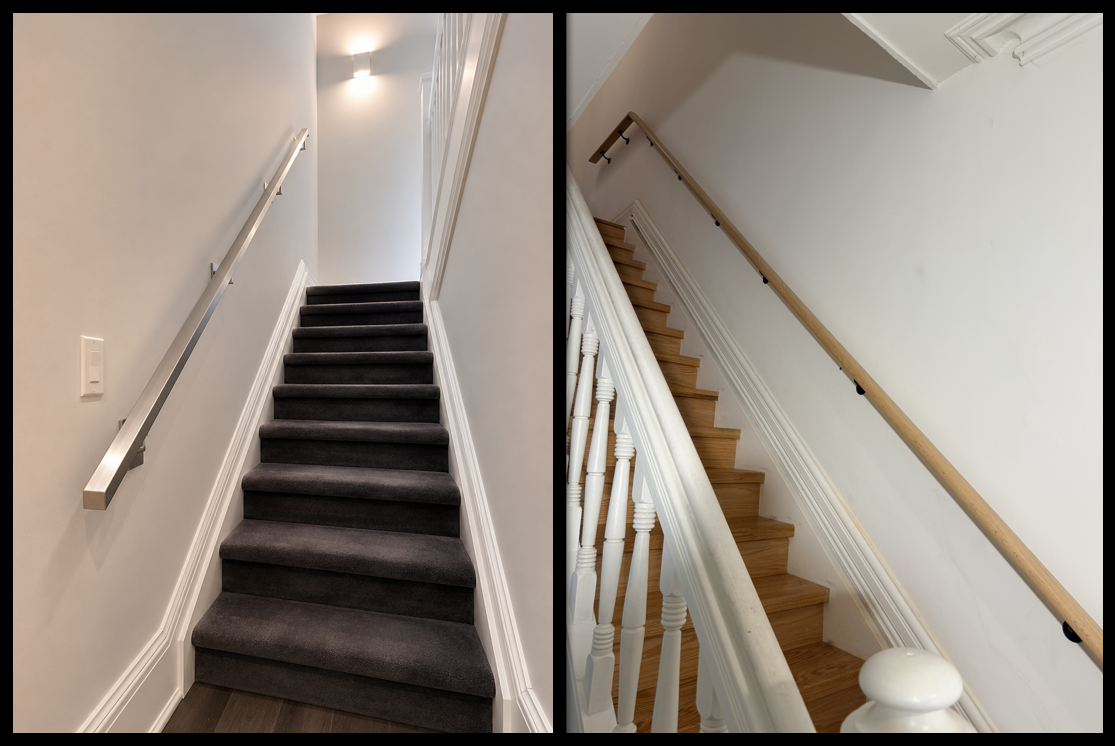
Should You Add a Second Handrail to Your Stairs?
One of the more common calls I get sounds something like this:
“My mother is coming home from hospital in a few days. The occupational therapist says she should have another handrail on the stairs. Can you do it before she gets home?”
Sometimes there is no handrail and we need to add one. More often, there is already a handrail or banister on one side and the recommendation is to add another rail to the opposite wall.
This comes up especially often after a fall, surgery or hospital or rehabilitation stay. But I also see it when someone is planning ahead, or when I am already in the home installing grab bars and the family realizes that the stairs could use attention too.
So, is a second handrail really worthwhile?
In many homes, yes. In fact, the Government of Canada’s Safe Living Guide for seniors specifically asks whether stairways have solid handrails on both sides. Canada’s fall prevention guidance also recommends having solid handrails on both sides of a stairway.
That does not mean every staircase with one handrail is unsafe or illegal. It does mean that adding a second rail is a well established fall prevention recommendation, and one worth considering before someone is struggling with the stairs.
What does the second handrail actually add?
I think this is more useful than simply saying that “two rails are safer than one.”
The people I work with do not all use stairs in the same way.
Someone may have a stronger and weaker side. They may have arthritis or shoulder pain. They may be recovering from surgery. They may have experienced a stroke. They may simply feel considerably more comfortable using one hand than the other.
Which rail is most useful can also change depending on whether the person is going up or coming down.
That is one reason an occupational therapist’s recommendation takes priority when one has been made. I install handrails. I do not assess someone’s medical condition or prescribe how that individual should climb the stairs.
But from an installation perspective, a second rail gives the person another option. Instead of the location of the existing railing determining which hand they must use, support can be available on either side.
McMaster University occupational therapy professor Brenda Vrkljan makes essentially this recommendation in her article on maintaining mobility as we age. Her suggestions include adding a second handrail so that both sides of indoor and outdoor staircases are covered, with particular attention to steep basement and attic stairs. She also recommends an occupational therapy home visit where individualized recommendations are needed.
“But there’s already a railing”
This is one of the most important things I see in actual Toronto houses.
There may be something to hold onto for most of the staircase, but that does not necessarily mean there is useful support for the entire trip.
A very common arrangement in older Toronto semi detached homes has a wall on one side of the staircase and a guard or traditional banister on the open side.
The banister may have worked perfectly well for decades.
But it often does not continue all the way through the transition at the top of the stairs.
For someone who has always been steady on their feet, that missing section may never have mattered. After a fall, an injury or a change in balance, it suddenly can.
I have been in homes where a new wall mounted handrail not only provided a second handhold, but could also be made longer than the existing banister and continue farther through that important transition.
This is why I do not think the right question is simply:
“Do I already have a railing?”
I would ask:
- Is there something secure to hold for the whole part of the staircase where support is needed?
- Does the handhold continue far enough toward the top and bottom?
- Can the person actually grip it comfortably?
- Is it on the side that works for them?
- Does it move when you pull on it?
- Would another rail give the person a useful choice of sides?
The home safety assessment material I use as one reference takes a similar approach. It asks whether interior stairs have sturdy rails on both sides, whether they are securely fastened, and whether the rails continue onto the landings.
Going downstairs can be a different problem from going upstairs
Clients frequently tell me that going down the stairs is more difficult or unsettling than climbing them.
There is research behind that experience.
A study of older adults published in Gait & Posture found that even relatively light use of a handrail changed stair mechanics, and during descent was associated with more effective balance control compared with descending without using the rail. The research is indexed by the U.S. National Library of Medicine here.
Toronto researchers have also looked specifically at what happens when people lose their balance while descending. Research involving Toronto Rehabilitation Institute and the University of Toronto found that people experiencing an unexpected balance disturbance often tried to grasp a nearby environmental support, including the handrail. You can read the study abstract here.
Toronto Rehab has an entire research program looking at stairs, falls and handrail design. UHN has a good plain language overview of some of that work in Setting a High Bar for Safety.
None of that tells an individual homeowner exactly how they should use their stairs. It does help explain why having a secure, reachable handhold matters.
The main staircase is usually the priority
In the homes I work in, the staircase from the main floor to the second floor comes up most often.
There is a practical reason.
A lot of Toronto houses have no bathroom on the main floor. If the bedroom and bathroom are upstairs, a person may need to climb those stairs several times every day.
In that situation, saying “avoid the stairs for now” may not solve much.
This is also why I often end up discussing handrails after another piece of safety work has already been arranged. The original call might have been about grab bars, a toilet safety frame, a transfer bench or shower equipment. Once the family starts looking at the route the person will actually use when they come home, the staircase becomes part of the same conversation.
Basement stairs are a different problem
Basement stairs are probably the second most common stairs I am asked to look at, and they can be much more challenging.
Many older Toronto basements were not originally treated as the living spaces they have since become.
I regularly encounter basement stairs that are steep, narrow, awkwardly laid out or surrounded by walls that make additional handrails difficult to fit.
This is one place where I would not automatically say, “Add another rail and carry on.”
If someone truly needs to use the basement, a second handrail may be very useful, and McMaster’s guidance specifically calls attention to steep basement stairs.
But sometimes the better question is whether the person needs to use those stairs at all.
I had one situation where a difficult set of steps was being used mainly because the homeowner occasionally needed to get to a gate to let visitors in. Rather than treating a handrail as the only possible solution, I suggested considering a coded or remote gate control so that the difficult route might not need to be used.
I think that is an important distinction.
The goal is not to install as many handrails as possible. The goal is to make the home work better and more safely for the person living there.
Before adding a second rail, I look carefully at the first one
Adding another handrail does not make much sense if the existing one is barely attached.
I have encountered existing rails with loose brackets, excessive spacing between supports and poor fasteners.
In one case, plastic anchors had been used where there was masonry behind the wall. The railing had also been removed at some point so that something large could be carried upstairs, then reinstalled even less securely.
This is more common than homeowners might think.
Moving furniture is also something worth discussing before putting another rail on a narrow staircase. Sometimes there is a tradeoff between maximizing stair support and preserving as much clearance as possible for furniture and other large objects.
If movers or another trade later removes a handrail, I strongly recommend making sure it is properly reinstalled rather than simply putting the old screws back into compromised holes.
What is the handrail actually attached to?
A handrail is not a coat hook.
When someone loses balance and reaches for it, the rail, the brackets, the fasteners and the wall structure all become part of the same load path.
In the Toronto houses where I work, masonry or concrete behind the wall is very common and often requires substantial brackets and appropriate masonry fastening. Drywall over wood studs is probably the next most common situation.
Then there are the less straightforward houses.
A rail may cross sections of different wall construction. The wall may be uneven. There may be plaster, old framing or poor substrate. Turns and landings create their own problems.
A simple straight wall with good structure behind it can make adding a second handrail a fairly straightforward job.
A narrow staircase with several turns and different mounting surfaces can turn it into a small design project.
Ontario’s handrail requirements reflect the fact that these are structural supports. The Code has historically specified that handrails and their supports be capable of resisting a concentrated load of 0.9 kN, roughly 200 pounds force, applied at any point and in any direction. Ontario’s official code material also contains prescriptive fastening provisions for residential handrails attached to wood studs or blocking.
Ontario now uses the 2024 Ontario Building Code, which adopted the National Building Code of Canada 2020 with Ontario amendments. The province keeps information and the current code resources on its Ontario Building Code page.
Does Ontario code require two handrails?
Not necessarily.
This is an important distinction between a minimum building requirement and a home safety recommendation.
Government of Canada fall prevention guidance recommends solid rails on both sides.
Building Code requirements are more specific and depend on things such as the type of building, staircase configuration and dimensions. Historically, an ordinary residential staircase within a dwelling could often satisfy the minimum requirement with a handrail on one side, while wider, curved and other types of stairs have different requirements. Ontario’s current code should always be checked for the particular project.
So it is entirely possible for a staircase to meet the applicable minimum requirement and for an occupational therapist or homeowner to reasonably decide that a second handrail would still be useful.
Those are not contradictory conclusions.
Sometimes I recommend replacing the rail rather than extending it
Another thing I run into is a handrail that simply ends too soon.
The obvious thought is:
“Can we just add another foot or two?”
Sometimes we can.
But extending an existing rail is often more complicated than it sounds.
The original profile may no longer be available. The stain may be difficult to reproduce. An extension has to be connected reliably to somebody else’s previous installation. By the time all of that is addressed, replacing the wall mounted rail with a longer continuous piece can actually be faster, less expensive and produce a better result.
From my perspective, it also gives me clearer responsibility for the finished assembly rather than relying on an old connection that I did not install.
If a horizontal continuation at the upper landing would be useful and there is room to do it properly, that can sometimes be incorporated into the replacement.
Will a second handrail look institutional?
It does not have to.
This is a concern I hear, particularly when someone has recently been told they suddenly need grab bars, bath equipment and another railing.
The house does not have to turn into a hospital.
Given enough time, I can often match or get very close to an existing handrail’s wood species, shape, stain, paint and brackets. The new rail can also be chosen to relate to the flooring, stair treads and overall style rather than simply copying what is on the opposite side.
I have done the same thing with metal. On one project, that meant finding stainless steel rail and hardware that matched the dimensions and brushed finish of the existing railing system.
There is, however, a real tradeoff between time and perfect matching.
If someone is coming home from rehabilitation on Friday and I get the call on Wednesday, my first priority is a secure and appropriate handrail.
If the homeowner wants a near perfect custom stain match, specialty milling or an artisan level finish, that may require more time or a finishing specialist.
Both are possible. They are just different projects.
If someone is coming home from hospital, do not wait until the last day
This is probably the most practical advice I can give.
Families often have much less time than they expected.
Sometimes the conversation about home modifications begins only a day or two before discharge.
Toronto Rehab’s geriatric rehabilitation program describes discharge preparation as part of helping people return to their community after illness or hospitalization, and its team includes occupational therapists and physiotherapists. Its Falls Prevention Program also specifically considers whether changes to the home may be needed and includes stair safety among the subjects addressed.
If your OT, physiotherapist or rehabilitation team says another handrail is needed, start looking at the staircase as soon as you can.
You do not necessarily need to have every detail figured out.
A few photographs are an excellent start.
I usually want to see:
- the entire staircase from the bottom
- the staircase looking down from the top
- the existing railing or banister
- the opposite wall
- the upper and lower landing
- any turns, doors or unusual obstructions
Those pictures can tell me whether the job is likely to be straightforward and help me start thinking about rail length, materials, brackets and fastening before arriving.
So, should you add a second handrail?
I think the best time to consider a second handrail is when you are already renovating the staircase.
The second best time is before you urgently need one.
In reality, most people wait.
The call comes after a fall, surgery, hospital stay or change in mobility, when somebody suddenly looks at a staircase they have used for 30 years and realizes that the support they always took for granted is not quite where they now need it.
If that is happening in your home, I would look at more than the number of rails.
Look at whether the existing rail is secure.
Look at where it starts and stops.
Look at which side the person can comfortably use.
Look at the transition at the top of the stairs.
Look at how narrow the staircase is.
And look at whether that staircase actually needs to be part of the person’s daily routine.
Canadian fall prevention guidance is clear that solid handrails on both sides are worth considering. The practical question is how to make that recommendation work in your particular home.
Need a second handrail installed in Toronto?
A large part of this work involves helping families prepare a home after a hospital or rehabilitation stay, often alongside grab bars and other practical safety improvements.
If a healthcare professional has already recommended a handrail, I am happy to work from that recommendation. If there is an installation issue that needs to be resolved, we can work through the practical options without pretending to replace the clinical advice.
For a first look, send clear photos of the staircase, the existing handrail and both landings. Straightforward second handrail installations are often quicker and less disruptive than homeowners expect.
About the Author
Jesse Black-Allen is the owner of Good Company, a Toronto-area home services business focused on safety, accessibility, and practical home improvements. He regularly installs handrails, grab bars, and other supports for older adults, people returning home from hospital or rehabilitation, and homeowners planning ahead for safer living at home. His work combines careful installation with a practical understanding of how people actually move through and use their homes.