
If you’re researching bathtub cutouts Toronto homeowners trust, you’re probably trying to make bathing safer without renovating your entire bathroom. Whether you’re planning ahead, recovering from surgery, or helping an aging parent remain at home, choosing the right solution can feel overwhelming.
A bathtub that once seemed perfectly normal can gradually become one of the most challenging places in the home. Stepping over the high tub wall may become painful, awkward or unsafe because of arthritis, reduced balance, injury, surgery or changing mobility.
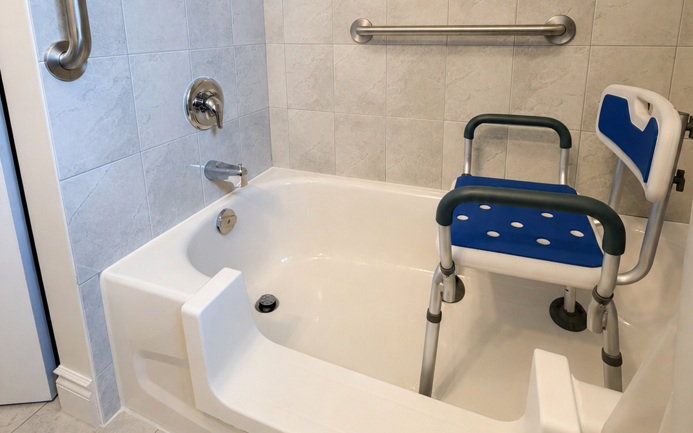
Fortunately, replacing the entire bathroom isn’t your only option. A professionally installed bathtub cutout lowers the step-over height of your existing tub, making it easier to enter and exit while preserving most of your bathroom.
This guide answers the questions Toronto homeowners ask most often about bathtub cutouts, including cost, installation, safety, waterproofing, alternatives, funding options and what to look for when comparing installers. It also explains when a bathtub cutout is an excellent choice and when another accessibility solution may better suit your needs.
If you’d like to book a free assessment or have a conversation click here.
Quick answers
What is a bathtub cutout?
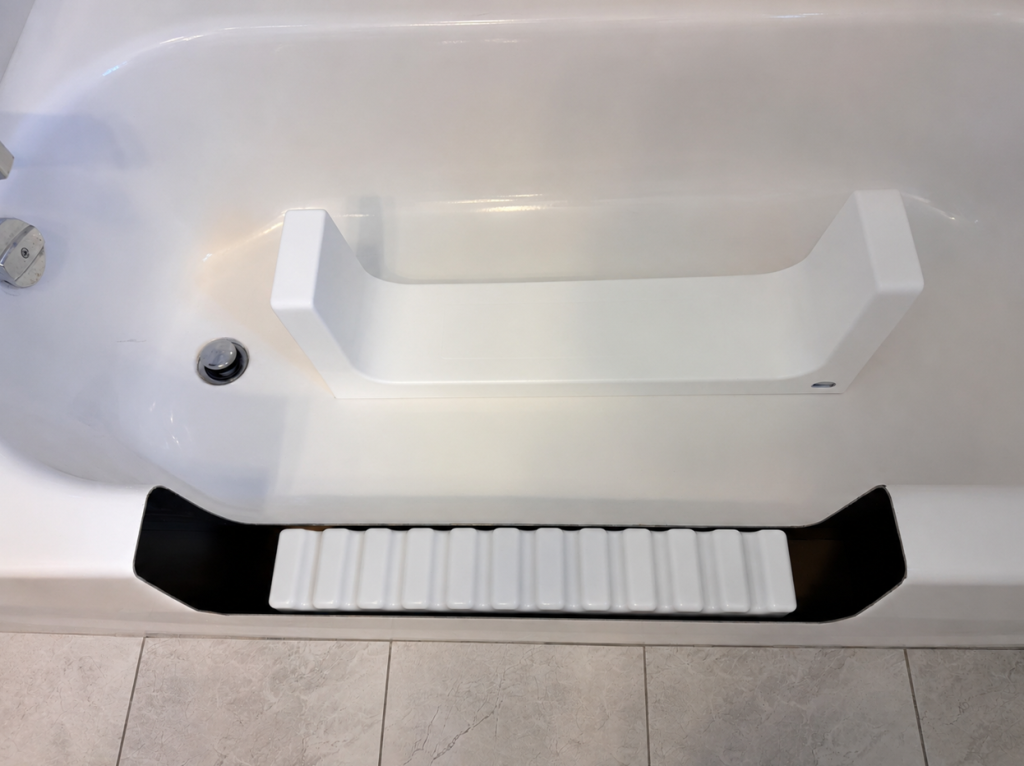
It is an opening made in the side of an existing bathtub and finished with a purpose-built step or conversion insert. The opening reduces the height a person must cross to enter or leave the tub.
How much does a bathtub cutout cost in Toronto?
The cost depends on the type of bathtub, the conversion system used, the complexity of the installation, and exactly what is included in the quote. In the pricing section below, we’ll explain the factors that affect cost, how to compare estimates fairly, and the questions every homeowner should ask before choosing an installer. If you receive another written estimate, we’re happy to review it with you. If it includes the same scope of work, materials and quality of installation, we’ll do our best to provide a competitive price.
How long does installation take?
Many straightforward installations can be completed in one visit. The tub and shower must then remain unused while the adhesive and sealants cure. Good Company normally advises allowing approximately 48 hours, unless the product instructions for that installation specify otherwise.
Can every bathtub be converted?
No. Steel, acrylic and fibreglass tubs may be candidates, but condition, shape, construction, plumbing, supports and available clearances must be assessed first.
Is a bathtub cutout the same as a walk-in tub?
No. A cutout modifies your existing tub. A walk-in tub is an entirely different fixture with a watertight door, built-in seating and a much higher purchase and installation cost.
Can you still take a bath?
A permanently open step conversion generally changes the tub into a step-in shower and prevents it from holding a full bath. Some conversion systems offer a removable watertight insert, but this must be selected as part of the project.
What is a bathtub cutout?
A bathtub cutout, sometimes called a walk-through tub conversion, lowers a section of the tub wall to create a more manageable entrance.
The installer marks and cuts an opening in the side of the existing tub. A purpose-built insert is then fitted over the opening, supported as required, bonded in place and sealed against water penetration.
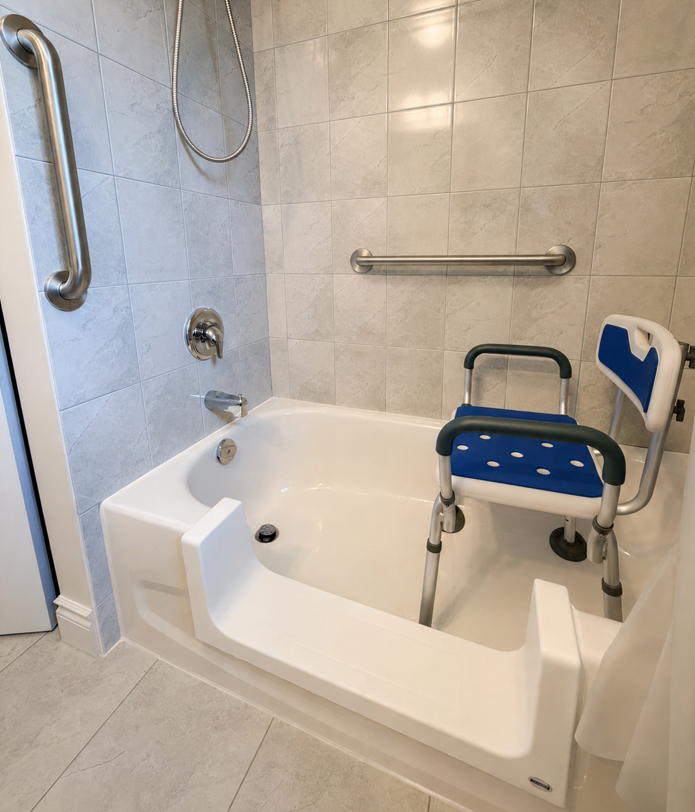
The result is not a completely level or curbless entrance. There is still a small threshold to cross. The difference is that the user no longer has to lift a leg over the full height of the original tub wall.
That distinction matters. A cutout may help someone who can still walk, stand or transfer with suitable support but has difficulty raising a leg high enough to clear the tub. It may not solve the problem for someone who needs a fully roll-in shower or substantial caregiver assistance.
CleanCut, one manufacturer of these systems, describes its step product as a conversion that creates a 24-inch opening and includes the step, support structure, industrial adhesive, cutting template and installation guide. The manufacturer estimates two to four hours for the basic installation, although actual professional job time depends on the tub and site conditions.
Who may benefit from a bathtub cutout?
A bathtub cutout may be worth considering when the main difficulty is crossing the side of the tub.
Common situations include:
- Reduced hip or knee movement
- Arthritis or joint pain
- Recovery from surgery or injury
- Difficulty balancing on one leg
- General changes in strength or mobility
- A desire to prepare the bathroom for aging at home
- A family member helping someone bathe
- A need for safer access without undertaking a full renovation
A cutout can be especially useful when combined with a transfer bench. The user can sit outside the tub, move across the bench and bring each leg through the opening without balancing on one foot.
Public Health Agency of Canada guidance recommends looking at bathroom safety as a combination of measures. These include firmly anchored grab bars, non-slip surfaces, bath seating where needed, good lighting and prompt removal of water from the floor.
That is why the right question is not simply:
Do I need a bathtub cutout?
It is:
What combination of changes will make bathing safer for this particular person?
When might a bathtub cutout not be the best option?
A responsible assessment should include the possibility that a cutout is not the right solution.
Another option may be safer when:
- The user cannot stand or transfer reliably
- A wheelchair-accessible roll-in shower is needed
- The person requires significant caregiver lifting
- The existing tub is cracked, badly rusted, loose or otherwise deteriorated
- Plumbing or mechanical equipment interferes with the proposed opening
- The tub has an unusual shape or structure
- The household still needs the tub to hold a full bath
- A full bathroom renovation is already planned
- The user’s needs are expected to change substantially in the near future
Cognitive needs also matter. Someone with dementia may require a very simple and familiar bathing setup, close supervision or professional recommendations that go beyond the physical construction of the tub.
For complex transfer or mobility needs, an occupational therapist can help evaluate how the person enters, sits, turns and exits. The final placement of grab bars and seating should be based on the actual user rather than a generic arrangement.
How much does a bathtub cutout cost in Toronto?
The cost of a bathtub cutout depends on the type of tub, the conversion system, the condition of the existing bathtub and exactly what is included in the installation.
What affects the price?
The bathtub material
Steel, acrylic and fibreglass behave differently when cut and finished.
A steel tub may require metal-cutting tools, edge preparation and protection of the exposed steel. Acrylic and fibreglass require different cutting methods and careful control to avoid cracking or splintering. Cast iron presents a different level of difficulty and may not be suitable for the same process.
The cutout system
A permanently open step is generally less complicated than a system designed to accept a removable watertight panel.
Different widths and depths may also be required depending on the shape of the tub wall.
The tub’s condition
Rust, movement, cracks, previous repairs or damaged finishes may require additional work or make the conversion unsuitable.
Access and working conditions
A small bathroom, difficult parking, condominium procedures, limited elevator access or more extensive protection requirements can add time.
Reinforcement and support
The installer may need to install or adjust the support structure beneath the step. This is not a decorative detail. The finished entry needs firm support.
Waterproofing and finishing
The insert must be bonded and sealed according to the product requirements. Surface preparation and final finishing can affect both appearance and long-term performance.
Additional safety equipment
Grab bars, a transfer bench, a handheld shower, non-slip treatments or toilet supports are separate products and may involve additional installation work.
What should a professional quote clarify?
When comparing prices, ask whether the quote includes:
- The conversion insert
- Adhesives, sealants and supporting materials
- Assessment of tub suitability
- Protection of floors and nearby surfaces
- Dust extraction or containment
- Cutting and edge preparation
- Support beneath the step
- Waterproof installation
- Cleanup
- Removal of the cut-off section and job debris
- Follow-up if the finish requires attention
- Warranty terms
- HST
- Grab bars or other safety equipment
A low advertised starting price may describe a basic installation under ideal conditions. That does not necessarily make it misleading, but it may not represent the final cost for your bathroom.
The most useful comparison is not simply one total against another. Compare the scope of work, the product, the installation method and what happens if additional work is discovered. installation method and what happens if extra work is discovered.
What happens before the tub is cut?
Good installation begins with assessment and preparation.
The installer should confirm:
- The tub material
- The wall thickness and shape
- The proposed opening size
- The tub’s condition
- Clearances around the opening
- Possible plumbing or other obstructions
- How the user is expected to enter and exit
- Whether the proposed location works with grab bars or seating
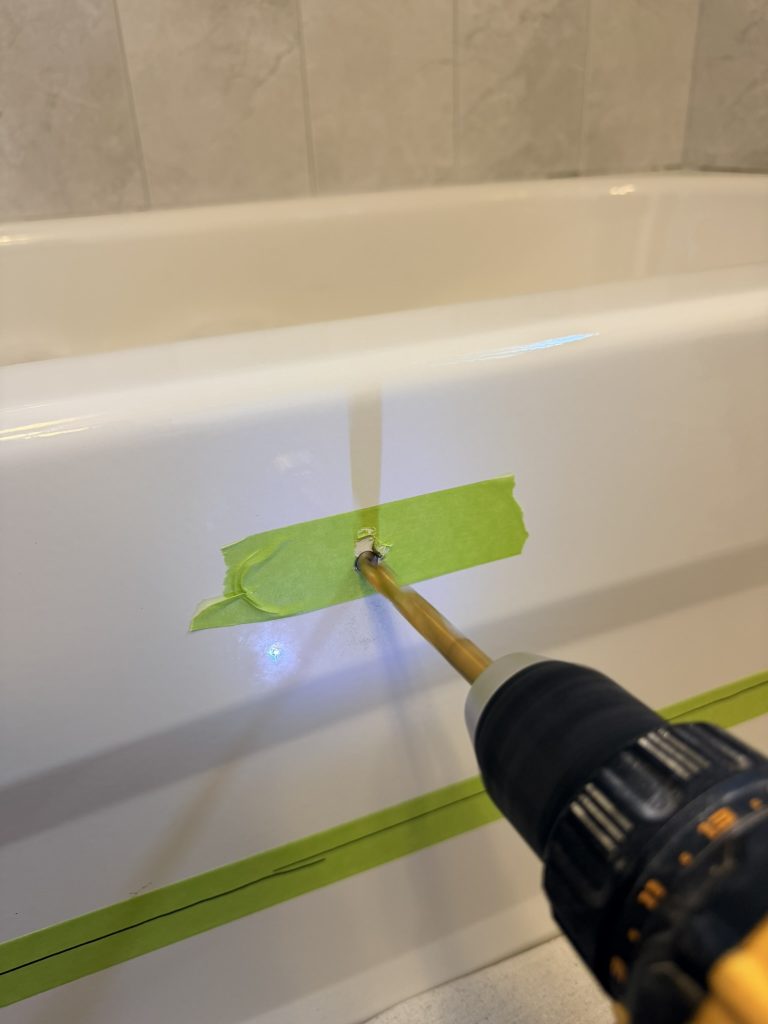
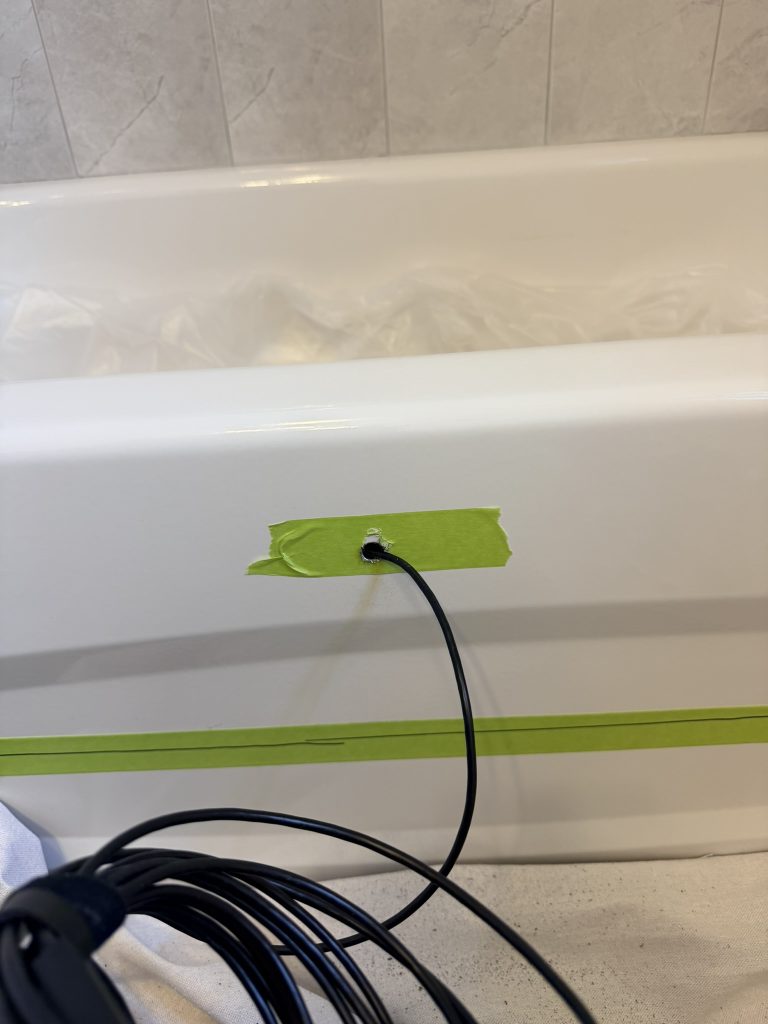
On a steel-tub project, Good Company used a small pilot opening and borescope to inspect the space before completing the larger cut. Not every tub will require exactly the same inspection method, but the principle is important: understand the tub and surrounding conditions before committing to the opening.
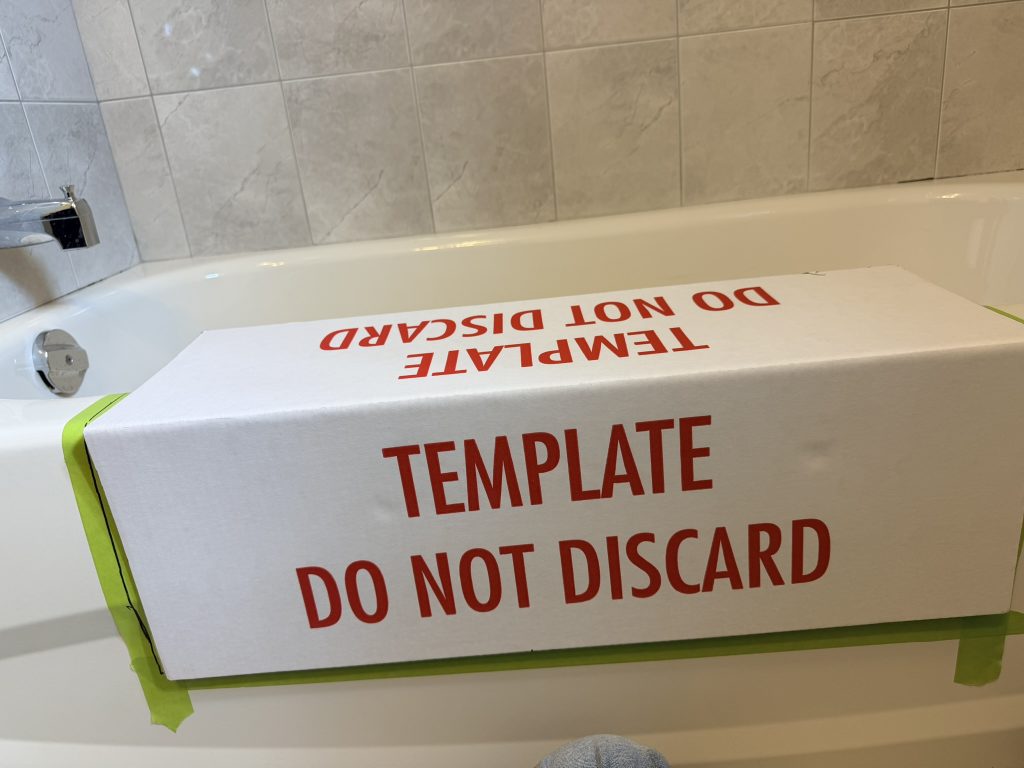
Step 1: Template layout
A manufacturer-provided template is positioned and checked before cutting. This controls the opening size and helps match it to the selected insert.
Step 2: Pilot opening and internal inspection
A small opening may be used to inspect the space inside the tub wall and verify that the planned cut is clear. This is typically the final inspection step, confirming earlier non-destructive assessments before the main opening is cut.
How is the bathroom protected during installation?
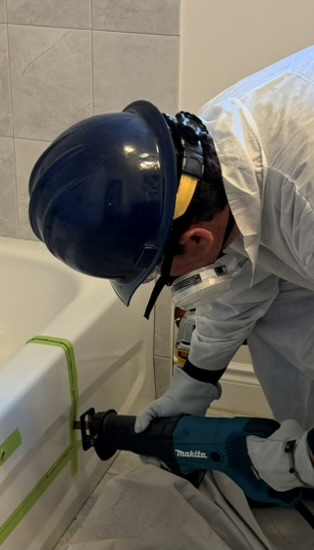
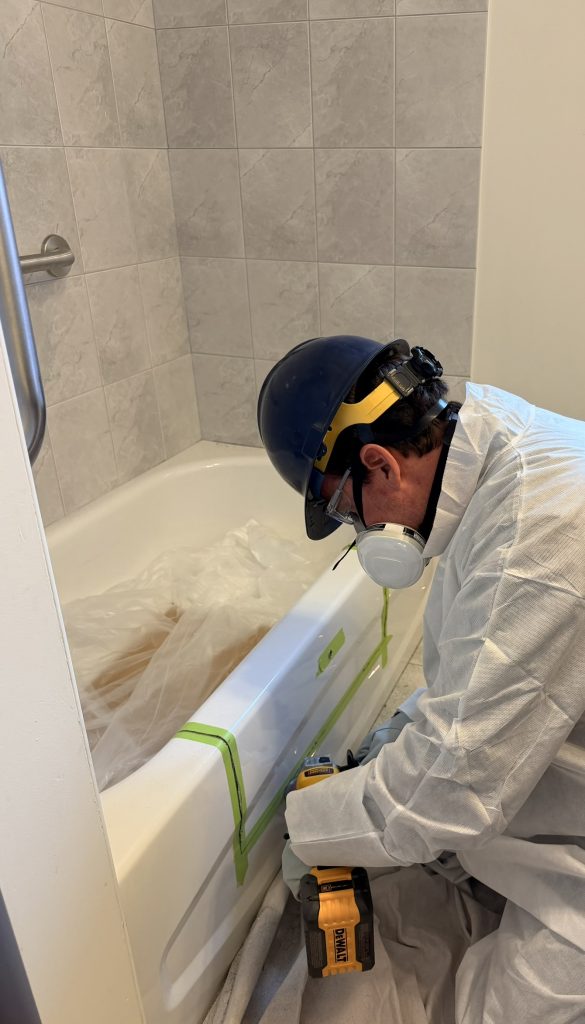
Cutting a tub creates noise, debris and, depending on the material and tools, dust or metal particles.
Professional preparation may include:
- Covering the bathroom floor
- Protecting nearby fixtures
- Moving personal items and textiles
- Using localized extraction
- Keeping tools and debris contained
- Cleaning the work area before leaving
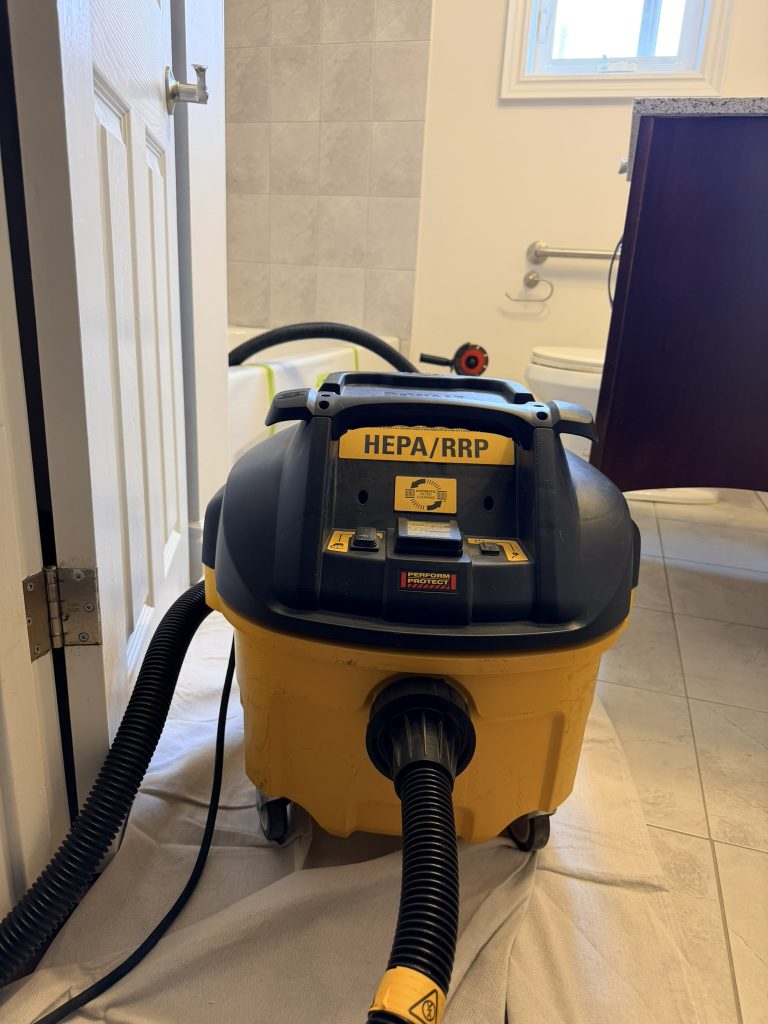
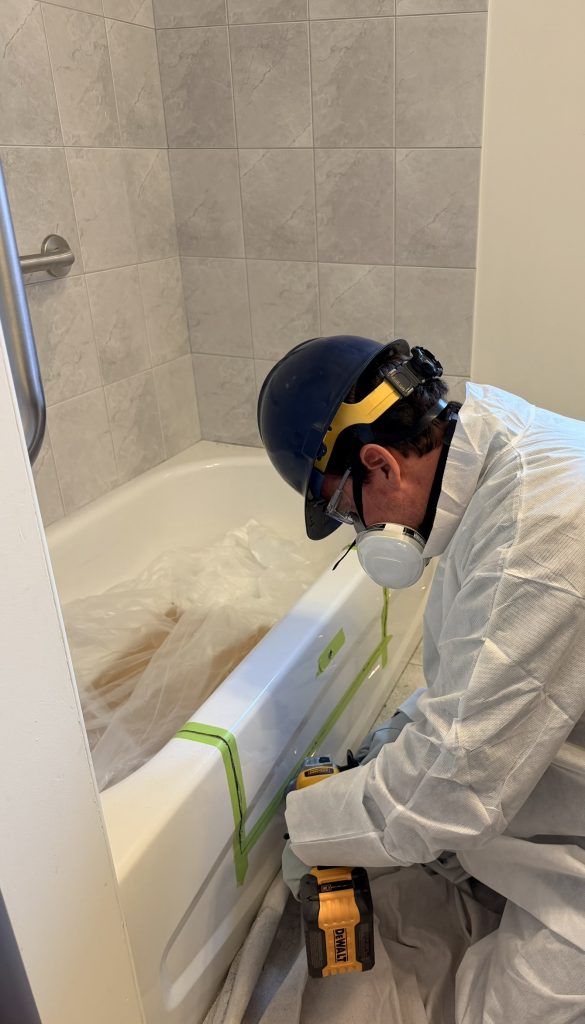
Good Company uses floor protection and HEPA dust extraction where appropriate. This does not mean that the work is entirely dust-free, but it substantially improves containment and cleanup.
This is also a useful point to discuss when comparing quotes. “Installation included” may not tell you what level of property protection and cleanup is included.
How is the opening cut?
The exact tools depend on the bathtub material and the manufacturer’s installation requirements.
For the steel tub shown in these photographs, the process involved controlled cutting with tools suited to metal. The installer followed the marked template, completed the opening and prepared the cut edges before fitting the step.
What supports the new step?
The insert is not simply cosmetic trim placed over a hole.
The system requires support underneath the new entry. The CleanCut Step, for example, is supplied with a two-part support structure as part of the conversion kit.
The support helps provide a stable base for the insert. The installer must fit the support and step to the actual bathtub while following the manufacturer’s requirements for bonding and sealing.
Support and waterproofing components are prepared beneath the new step before the insert is permanently bonded and sealed.
Will a bathtub cutout leak?
A properly installed conversion is designed to withstand normal shower use. The insert is bonded and sealed to the tub using the manufacturer-specified adhesive system.
However, no wet-area seal should be treated as something that can be ignored forever.
Homeowners should:
- Follow the required cure time
- Avoid disturbing the insert
- Watch for separation, cracking or movement
- Report any change promptly
- Keep the surrounding area clean
- Follow installer and manufacturer maintenance instructions
- Arrange inspection or resealing if the bond or finish appears compromised
Good Company normally advises clients not to use the tub or shower for approximately 48 hours after installation, unless the specific product requirements call for a different period. The toilet and the rest of the bathroom can still be used.
Can a steel bathtub be converted?
Many steel tubs can be suitable candidates. The project shown throughout this article involved a steel bathtub.
Steel requires a process appropriate to enamel-coated metal. The cut must be controlled, sharp or burred edges must be prepared, and the insert must be properly supported and bonded.
Suitability still depends on:
- Tub condition
- Rust or corrosion
- Shape and width
- Access
- Interior obstructions
- The selected conversion kit
A photograph alone is not always enough to confirm suitability. Measurements and an in-person assessment may be needed.
Can an acrylic or fibreglass bathtub be converted?
Many acrylic and fibreglass tubs can also be converted, but they behave differently from steel.
The installer must consider:
- The thickness and flexibility of the tub wall
- The possibility of cracking or chipping
- Existing movement in the tub
- The shape of the apron
- Internal reinforcement
- Compatibility with the selected insert
A thin or unsupported tub wall may require particular care. An existing crack or unstable tub could make conversion unwise.
Can a cast-iron bathtub be converted?
Cast iron is substantially harder and more brittle than steel, acrylic or fibreglass. Some specialist systems or installers may accommodate certain cast-iron tubs, but it should not be assumed that a standard conversion method will apply.
Before proceeding, the installer should confirm:
- That the chosen product is approved for the tub
- That suitable cutting and containment methods are available
- That the tub is structurally sound
- That the expected result justifies the added difficulty and cost
In some cases, replacing the tub or choosing another accessibility solution may be more practical.
Are bathtub cutouts safe?
A bathtub cutout can reduce one important hazard: the need to raise a leg over the full tub wall.
It does not eliminate every bathroom risk.
Public Health Agency of Canada guidance recommends a combination of well-anchored grab bars, non-slip surfaces, bath seating where needed, good lighting and clear walking routes. Bathrooms and stairs are identified as particularly hazardous areas in the home.
A safer bathing setup may include:
Properly installed grab bars
Grab bars can help with balance, controlled sitting and standing, and movement across a transfer bench.
They must be attached to an appropriate structure. Towel bars, soap dishes and suction-mounted accessories should not be relied upon as permanent weight-bearing supports. The federal Safe Living Guide specifically advises that grab bars be firmly anchored.
A transfer bench or bath seat
A transfer bench extends outside and inside the tub. It allows the user to sit before bringing their legs through the opening.
A bath seat located entirely inside the tub can be helpful for someone who can safely enter but has difficulty standing throughout a shower.
A handheld shower
A handheld shower makes seated bathing more practical and reduces the need to reach or turn.
Non-slip surfaces
The floor, tub and step should provide appropriate traction. Loose mats can create a separate trip hazard, so bathroom mats should have secure non-slip backing.
Suitable lighting
The entrance, controls, grab bars and floor should be easy to see, including during nighttime bathroom visits.
Individualized placement
The best grab-bar position depends on the person, the bathroom and the way they transfer. Standard arrangements are useful starting points, but they are not substitutes for understanding the actual user.
Do I need a transfer bench?
Not everyone does, but many people who request a bathtub cutout would benefit from discussing one.
A transfer bench may be especially helpful when the user:
- Has difficulty balancing on one leg
- Tires while standing
- Needs to sit before entering
- Uses a walker
- Is recovering from surgery
- Receives assistance from a caregiver
- Has limited hip or knee movement
The bench must fit the tub and bathroom. Its legs need stable contact with the floor and tub, and it must not interfere with the shower curtain, controls or safe movement through the opening.
A cutout and transfer bench solve related but different problems. The cutout reduces the barrier. The bench reduces the need to step and balance while crossing it.
How long does installation take?
A straightforward project may be completed in one working visit. Actual time depends on:
- Tub material
- Access
- Required inspection
- Cutting difficulty
- Edge preparation
- Support fitting
- Surface preparation
- Insert type
- Cleanup
- Additional grab-bar work
The manufacturer of the CleanCut Step describes the product itself as a two-to-four-hour installation. A professional appointment may take longer because it includes preparation, property protection, assessment, finishing and cleanup.
After installation, the tub and shower must stay dry during curing. Good Company generally advises approximately 48 hours.
Clients should receive the cure time in writing because using the shower too soon can compromise the bond and seal.
What are the alternatives to a bathtub cutout?
A cutout is only one of several ways to improve bathtub access.
Grab bars without a cutout
Grab bars may be enough when the user can still cross the tub wall but needs better balance and hand support.
Advantages:
- Lower cost
- Minimal disruption
- Can be positioned for the individual
- Useful even if other changes are made later
Limitations:
- The full tub wall remains
- The user may still need to balance on one leg
- Placement and attachment structure are critical
Transfer bench without a cutout
A transfer bench can allow a person to sit outside the tub and move across without standing over the tub wall.
Advantages:
- No permanent tub modification
- Often relatively affordable
- Can be removed
- Useful during temporary recovery
Limitations:
- The user still has to bring both legs over the tub wall
- It occupies floor space
- Shower-curtain management can be awkward
- It may not fit every bathroom
Clamp-on bathtub rail
A tub rail clamps to the side of a suitable bathtub and provides a handhold.
Advantages:
- No wall drilling
- Removable
- Useful in certain layouts
Limitations:
- It must be compatible with the tub’s wall shape
- It does not lower the entrance
- It should not replace properly located wall-mounted grab bars when greater support is needed
- Compatibility and secure clamping must be checked regularly
Bath lift
A powered bath lift lowers the user into the bath and raises them again.
Advantages:
- Allows continued soaking
- No permanent modification to the tub
- Helpful for some users with difficulty lowering or standing
Limitations:
- The user must still transfer onto the lift
- Equipment requires storage, charging and maintenance
- It may reduce usable tub space
- It does not solve access from the bathroom floor to the seat
Removable watertight cutout insert
Some systems combine a step-through opening with a removable panel that allows the tub to hold water.
Advantages:
- Preserves the option of taking a bath
- Lower entry when the panel is removed
Limitations:
- Higher product complexity and cost
- The panel must be properly installed each time
- Not ideal for every user or caregiver
- Seals require inspection and care
Walk-in bathtub
A walk-in tub replaces the existing bathtub with a purpose-built unit featuring a door and built-in seat.
Advantages:
- Low entry
- Built-in seating
- Bathing features may be available
- Designed as a complete system
Limitations:
- Much higher product and installation cost
- Plumbing and electrical work may be required
- The user must normally enter before filling and wait while it drains before opening the door
- Significant renovation and disruption may be involved
One Toronto renovation cost guide places walk-in-tub installation labour and related work at roughly $3,500 to $5,500, in addition to estimated hardware costs of $5,000 to $10,000. Actual quotations vary widely, but this illustrates the scale of difference from modifying an existing tub.
Tub-to-shower conversion
The existing bathtub is removed and replaced with a shower base or custom shower.
Advantages:
- Can create a wider bathing area
- May provide a very low threshold
- Allows substantial redesign
- Can accommodate seating and grab bars
Limitations:
- More expensive
- More disruptive
- Requires demolition, plumbing, wall finishing and waterproofing
- May take several days or longer
- Removing the home’s only bathtub may matter to some future buyers
Curbless or roll-in shower
This is often the best long-term option for someone using a wheelchair or requiring substantial caregiver assistance.
Advantages:
- Minimal or no threshold
- Greater transfer space
- Can be designed around future needs
- May accommodate wheeled shower equipment
Limitations:
- Major renovation
- Careful drainage and waterproofing design required
- Usually the most expensive option
- Not practical in every bathroom structure
How do I choose between the options?
Start with the person, not the product.
Useful questions include:
- What part of bathing is currently difficult?
- Can the person stand safely?
- Can they sit and rise without help?
- Can they bring each leg through a lower opening?
- Do they need caregiver assistance?
- Is the need temporary, progressive or long term?
- Is bathing in a full tub still important?
- Is a wheelchair-accessible solution likely to be needed later?
- Can the bathroom accommodate a transfer bench?
- Are suitable grab-bar mounting locations available?
- What is the realistic budget?
- Is a larger renovation already planned?
Sometimes the lowest-cost solution is enough. Sometimes spending slightly more now avoids having to redo the bathroom soon afterward.
For complex mobility or transfer concerns, an occupational therapist can help match the physical environment to the user’s abilities.
How should I compare bathtub-cutout installers?
Price matters, but it should not be the only question.
Ask prospective installers:
What kind of tubs do you convert?
The installer should be able to explain the difference between steel, acrylic, fibreglass and other materials.
How do you assess suitability?
Look for a real assessment of the tub’s condition, shape, dimensions and surroundings.
What product will you use?
Ask for the manufacturer and model or conversion type.
What is included in the price?
Clarify materials, labour, support, sealing, floor protection, cleanup, disposal, HST and additional safety equipment.
How is the step supported?
A professional should be able to explain what sits beneath the finished insert.
What property protection do you use?
Ask how the bathroom floor and fixtures will be protected and how debris will be controlled.
How long must the shower remain unused?
The answer should be specific to the adhesive system.
What maintenance is required?
You should receive practical information about monitoring seals and reporting movement.
What warranty or follow-up is provided?
Understand what is covered, for how long, and what the homeowner must do if a concern appears.
Are you insured?
The installer should carry appropriate business liability insurance.
Can you also assess grab bars and seating?
The safest result often depends on how the entire bathing setup works together.
Are grants, tax credits or insurance available?
Funding depends on the person, the purpose of the work and current program rules. Approval should never be assumed.
Possible avenues include:
Ontario Home and Vehicle Modification Program
Ontario’s seniors-services guide identifies the Home and Vehicle Modification Program as a potential source of funding for qualifying people whose disabilities restrict mobility and daily function. It lists up to $15,000 as the lifetime maximum for home modifications. The program is administered through March of Dimes Canada and has eligibility and application requirements.
Ontario Seniors Care at Home Tax Credit
Ontario describes this as a refundable tax credit for eligible low- to moderate-income seniors. The province lists bathroom aids such as grab bars and certain renovations that improve mobility, access or functioning among potentially eligible medical expenses. Eligibility depends on income, medical-expense rules and the nature of the work.
Veterans Affairs Canada
The Veterans Independence Program may contribute toward necessary home adaptations for eligible veterans. Veterans Affairs Canada specifically identifies safety alterations such as grab bars, handrails, shower seating, anti-scald measures and slip-resistant surfaces among examples that may be considered. Preauthorization and assessed need may apply.
Private insurance or workplace benefits
Some private plans, union benefits or accident-related coverage may reimburse home modifications when supported by medical or occupational-therapy documentation. Coverage varies by policy.
Income-tax medical expenses
Certain accessibility renovations or devices may qualify under federal or provincial tax provisions, but eligibility depends on the taxpayer, the medical need and the specific expense.
Before relying on assistance:
- Ask whether preapproval is required
- Obtain a detailed written estimate
- Keep invoices and proof of payment
- Ask whether medical documentation is needed
- Confirm whether labour, materials and HST are eligible
About the Author
Jesse Black-Allen is the founder of Good Company, a Toronto home accessibility and safety business specializing in grab bars, railings, bathtub cutouts and practical modifications that help people remain safe and independent at home. He believes homeowners deserve clear information, quality workmanship and straightforward advice, whether they hire Good Company or not.
For more information or to request a quote, visit https://goodcompanyhome.com/contact/.
Frequently Asked Questions:
-
How much does a bathtub cutout cost in Toronto?
The cost depends on the type of bathtub, the conversion system, the complexity of the installation, and exactly what is included in the quote. Comparing estimates based on price alone can be misleading, so be sure to compare the scope of work, materials and installation methods as well.
-
Can any bathtub be converted?
No. Many steel, acrylic and fibreglass bathtubs can be converted, but suitability depends on the tub’s condition, construction and layout. Every installation should begin with an assessment.
-
Can I still take a bath after a bathtub cutout?
A permanently open bathtub cutout is designed primarily to improve shower access and will no longer hold a full bath. Some systems offer a removable watertight insert, allowing the bathtub to be used for both bathing and showering.
-
How long does a bathtub cutout installation take?
Many straightforward installations can be completed in a single visit. The exact time depends on the bathtub, the installation requirements and any additional accessibility work being completed at the same time.
-
How long before I can use my shower again?
The bathtub and shower should remain unused until the adhesive and sealants have fully cured. We typically recommend waiting about 48 hours, although the exact curing time depends on the manufacturer’s instructions for the product being installed.
-
Will a bathtub cutout leak?
When properly installed and maintained, a bathtub cutout is designed to provide a durable, watertight seal for normal shower use. Like any sealed area in a bathroom, it should be inspected periodically and any signs of movement or deterioration should be addressed promptly.
-
Are bathtub cutouts safe?
For many people, yes. A bathtub cutout reduces the height of the step into the tub, but it works best as part of a complete bathroom safety plan that may also include properly installed grab bars, a transfer bench, non-slip surfaces and good lighting.
-
Do I need grab bars with a bathtub cutout?
In many cases, yes. A bathtub cutout reduces the height of the step, but it does not provide hand support. Properly installed grab bars often play an even greater role in improving safety and independence.
-
Is a bathtub cutout better than a walk-in tub?
Not necessarily. A bathtub cutout is generally less expensive and far less disruptive because it modifies your existing bathtub. A walk-in tub may be a better choice for someone who still wants to soak in a bath or has more advanced mobility needs. The best option depends on the individual and their bathroom.
-
Is a bathtub cutout better than a walk-in shower?
It depends on your needs. A bathtub cutout can be an excellent solution when stepping over the tub wall is the main challenge. A walk-in or curbless shower may be more appropriate for someone with significant mobility limitations or who uses a wheelchair.
-
Are there grants, tax credits or insurance programs that can help?
Possibly. Depending on your circumstances, you may qualify for government programs, tax credits, veterans’ benefits or private insurance coverage for accessibility improvements. Eligibility varies, so it’s important to check the current requirements for each program.
-
Can I install a bathtub cutout myself?
Some manufacturers sell kits intended for professional installation, but the work involves accurately cutting the tub, inspecting for hidden obstructions, reinforcing the opening, waterproofing the installation and following the manufacturer’s instructions. An improperly installed cutout can compromise both safety and water resistance.
-
How do I know if a bathtub cutout is the right solution for me?
Every bathroom and every person’s mobility needs are different. In some cases, a bathtub cutout is the ideal solution. In others, grab bars, a transfer bench, a walk-in shower or another accessibility product may be a better fit. A professional assessment can help determine the safest and most practical option for your home.